
Bardo · The Oath
Chapter 2
The Lute
At six, Theo discovers the lute, Maud's discipline, and the difference between hearing music clearly and earning the skill to play it.
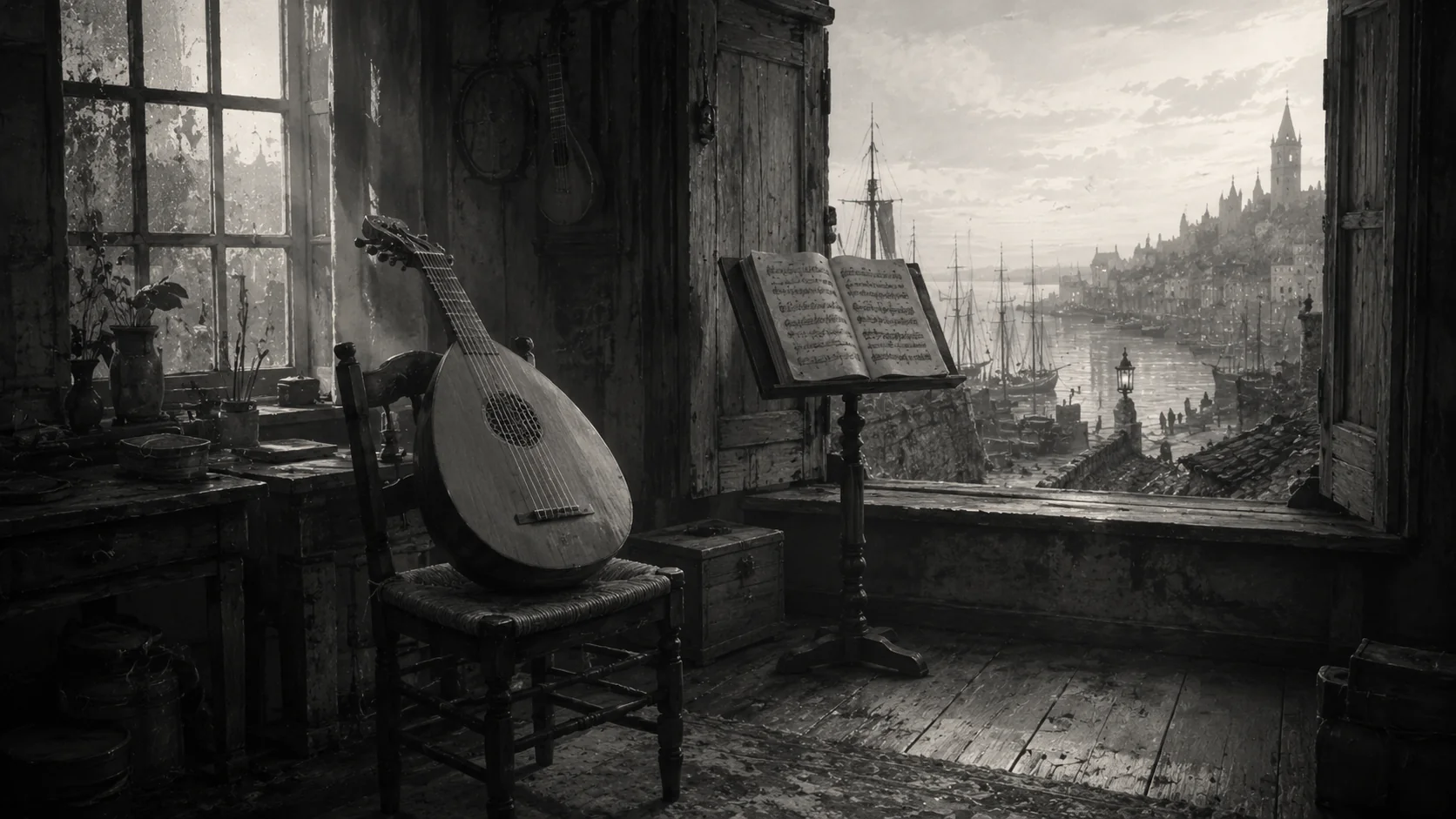
Theo chose the lute because somebody outside was hitting a fish crate with a spoon.
This was not how Maud Fenwick told the story later.
According to Maud, Theo had shown an early sensitivity to paired courses, coastal modes, and the relationship between formal melody and working rhythm. According to Theo, a visiting musician at Avelos House had been playing something beautiful in the music room while a dockhand in the alley behind the window beat almost the same pattern against an empty crate.
The two sounds did not match.
That was why he could not stop listening.
He was six, recently enrolled in school, and still young enough to believe that adults arranged interesting things on purpose.
The musician sat beneath the west window with a long-necked lute resting against one knee. The instrument had a narrow pear-shaped body, a dark neck, and five paired courses that answered with a bright shimmer whenever the player’s fingers left one string vibrating against its twin.
Outside, someone struck the crate.
Three quick blows. Pause. Two slower.
Inside, the musician’s thumb returned to the lower course on the same spacing, not copying the dock rhythm exactly but leaning against it.
Theo stood in the doorway.
The musician stopped.
“Am I in trouble?” Theo asked.
“You are blocking the hall.”
“That is not usually a musical offense.”
The man looked toward Maren, who was speaking with two Relief Fund visitors near the piano. “Yours?”
“Frequently,” she said.
Theo stepped into the room.
“What is that?”
“A lute.”
“There are smaller ones.”
“There are smaller people.”
Theo considered the answer and decided he liked the man.
“Why two strings for every note?”
“Not every note. Most.”
“Why?”
The player plucked one course, then stopped one string with a fingertip and plucked again.
The first sound seemed to open after it began. The second remained narrower.
“That,” the musician said.
Theo frowned. “That is not an explanation.”
“It is if your ears work.”
They did.
The paired strings were not perfectly identical. One arrived against the other and made the air flicker. Theo could hear a small movement between them, a brightness that appeared because two almost-same things refused to become one.
He moved closer.
“Again.”
The musician played the phrase again.
Outside, the spoon struck the crate.
Theo turned his head.
The musician smiled. “There it is.”
“What?”
“The reason your mother said you keep ruining dinner by tapping on the table.”
“I improve dinner.”
Maren looked over. “You have improved three cups onto the floor this month.”
Theo ignored this slander.
The visiting musician finished the piece. By supper Theo had learned his name, forgotten it twice, and remembered every note of the opening line.
The next morning Maud Fenwick arrived with six instruments.
Maud was not what Theo had expected from a music teacher.
He had expected somebody taller.
This was not a reasoned expectation. Music seemed large. Teachers in stories were large. Maud was a small woman in her forties with iron-gray threaded through dark hair, practical shoes, and the expression of someone who had once tolerated nonsense professionally and no longer intended to do so for free.
She put the instruments in a row across the music-room carpet.
Two short-necked lutes. A cittern. A small harp. A bowed instrument Theo did not know. The long-necked coastal lute.
Theo went directly to the last.
Maud watched him. “Why?”
“It sounds better.”
“Than what?”
He pointed to the bright short-necked lute beside it.
“You haven’t heard that one.”
“I heard one at Founders’ supper.”
“That was a mandora.”
“It sounded polite.”
“And politeness offends you?”
“When it has strings.”
Maud looked toward Maren. “You did not exaggerate.”
“I omitted several things.”
Theo knelt beside the long-necked instrument.
It was too large for him. He knew this immediately and decided the problem belonged to his future arms.
Maud sat opposite him.
“Show me the rhythm from yesterday.”
Theo tapped three quick beats on his knee, paused, then two slower.
“Again.”
He repeated it.
“Now the melody.”
Theo hummed the first phrase the visiting player had used.
Maud’s eyes changed slightly.
Not surprise exactly. Attention.
He liked it.
“Again,” she said.
He hummed it.
“Last interval is low.”
“No, it isn’t.”
Maud lifted one eyebrow.
Theo sang the last two notes again.
She went to the piano, found them, and played the interval.
Theo heard the difference immediately.
“Oh.”
“An excellent word. Musicians should keep it available.”
She played the phrase correctly.
Theo copied it.
This time Maud smiled.
He liked that even more.
“Can I learn the lute?”
“You can begin.”
“How long until I can play the piece from yesterday?”
“Which version?”
“The good one.”
“Six months if you practice intelligently.”
Theo stared at her.
“Six months?”
“Perhaps eight, given your face.”
“I know the notes.”
Maud held out the lute. “Then play them.”
Theo took the instrument.
His left hand could not comfortably reach the third position. The neck slid against his thumb. His right hand struck two paired courses when he wanted one. The first note buzzed. The second barely sounded. By the fourth his wrist hurt.
He stopped.
Maud said nothing.
Theo tried again.
The phrase came out as a series of small wooden accidents.
“I can hear it,” he said.
“Yes.”
“My fingers are doing something else.”
“Yes.”
“That seems badly designed.”
“Your fingers?”
“The instrument.”
Maud took it from him and played the phrase cleanly.
Theo disliked her for almost seven seconds.
Then she handed it back.
“Hearing is a beginning,” she said. “Not an accomplishment.”
Theo adjusted his grip.
He would remember the sentence because it annoyed him.
The first month was humiliating.
Theo had been praised for his ear often enough to assume music would appreciate him in return.
Music did not.
His fingertips blistered. Maud made him practice open courses without melody. She stopped him when his shoulders rose. She stopped him when he rushed. She stopped him when he played something difficult badly instead of something simple well.
Corin discovered that the same five exercises occurred every morning and began naming them.
“The March of Regret,” he announced from the doorway as Theo repeated a scale.
Theo kept playing.
“The Ballad of Why Is He Still Doing This.”
Theo changed direction without missing the beat.
“The Widow’s Plea for Quiet.”
Theo stopped. “You are eight.”
“Art recognizes no age.”
Tessa entered behind him carrying a wooden horse and climbed onto the window seat.
“Do the fast one.”
“I am not allowed.”
“Why?”
“Because Maud hates joy.”
From the hall Maud said, “Your tempo was unstable.”
Theo closed his eyes.
Corin left before he could be assigned work.
Tessa stayed.
She listened to the scale three times, then began singing an invented word over every fourth note.
“Stop.”
She sang louder.
“Tessa.”
“Ta.”
“Please.”
“Ta.”
Theo reached the top note, lost patience, and snapped, “You are ruining it.”
Tessa stopped.
The room became larger around the silence.
She put down the wooden horse and slid from the window seat.
Theo wanted immediately to take the words back. At six, he had already discovered that apologies arrived much faster in the mind than in the mouth.
Maud leaned against the doorframe.
“She was not affecting your hands.”
“She was affecting my ears.”
“You have two of those. Use the other one.”
Theo glared at her.
Maud did not rescue him from the thing he had said.
He put the lute down and followed Tessa.
He found her beneath the dining table with the wooden horse.
“I’m sorry.”
She turned the horse away from him.
“You weren’t ruining it.”
“Yes I was.”
“You were making it harder.”
She considered this improvement.
“I don’t like when it is harder.”
“I know.”
“Maud says hard is the part you practice.”
Theo suspected Maud had recruited his sister.
Tessa moved the horse two inches toward him.
“Can I sing?”
“Yes.”
“Loud?”
“Not as a moral principle.”
She did not understand the sentence but recognized surrender when she heard it.
That afternoon Theo played the scale while Tessa sang ta over every fourth note.
By the end, he could keep time anyway.
Maud said nothing about the exercise.
Which meant it had probably been one.
By summer the lute no longer looked enormous in his lap. It merely looked optimistic.
Theo could play three short pieces without stopping. He could tune by ear faster than Maren could find the pitch pipe. He had also learned that tuning quickly and tuning correctly were separate virtues, a distinction Maud enforced without mercy.
One afternoon she took him to the harbor.
“Why?” Theo asked.
“Because you think music lives in this room.”
“I heard it from the alley first.”
“Good. Then we may save time.”
They walked down through Ternwick’s western streets toward the piers.
The harbor sounded different when Maud told him to listen without naming anything.
Rope blocks clicked against masts. Hammer crews worked in staggered groups so one team could hear another. Fish sellers pitched calls to carry through wind. Wagon bells used intervals different from Guard bells. Sailors hauling a line sang short phrases whose final note told everyone when to pull.
Theo had heard all of it before.
He had not understood how much of it was instruction.
At the west quay, three Charter Guards practiced signal calls from a raised platform.
One held red and white flags. Another worked a brass plate. A third stood fifty yards away beside a speaking tube and wrote every received message on a slate.
Theo stopped walking.
The Guard uniforms were charcoal-blue, dark enough to make the white bridge at each collar look brighter. He knew the emblem. Everyone in Ternwick did. Guards reopened roads after storms, escorted medicine inland, found missing boats, and appeared in relief stories with an irritating tendency to make dangerous work sound ordinary afterward.
Theo liked them in the uncomplicated way children liked people whose jobs came with visible competence.
The signaler struck the brass plate.
Four notes. Pause. One.
Theo hummed the answer.
Maud looked at him. “What does it mean?”
“I don’t know.”
“Then you do not know the answer.”
“I know the notes.”
“Those are not the same thing.”
The second Guard raised two flags. The distant receiver answered incorrectly.
Theo heard it before the signaler moved.
“He changed the last interval.”
“Yes.”
“By accident?”
“Probably.”
The signaler did not copy the error. She repeated the original phrase, slower.
The receiver corrected.
Theo watched.
“If this were ensemble playing,” he said, “you would follow.”
“If this were ensemble playing, following might preserve the music.”
“And here?”
“Following might send a wagon onto a closed road.”
The brass plate sounded again.
The rhythm was not beautiful in the way the visiting musician’s piece had been beautiful. It was too plain. Too repetitive. Built to survive distance rather than reward attention.
Theo loved it immediately.
On the walk home he tapped the call against his thigh.
Four notes. Pause. One.
“What are you doing?” Maud asked.
“Remembering.”
“Then remember the meaning too.”
“I don’t know it.”
“Find out.”
Theo did.
The call meant road open, proceed under watch.
He wrote the words above the notes in his practice book.
Years later the page would be stained, corrected, and almost illegible beneath newer exercises. At six it was still clean enough that the distinction looked simple.
A song could survive a mistake.
A signal had to carry somebody safely to the next place.
Theo practiced both.