
Bardo · The Oath
Chapter 1
The Basket
At six, Theo learns how a nameless infant in a willow basket became Theodoros Avelos—and why he prefers the smaller name Theo.
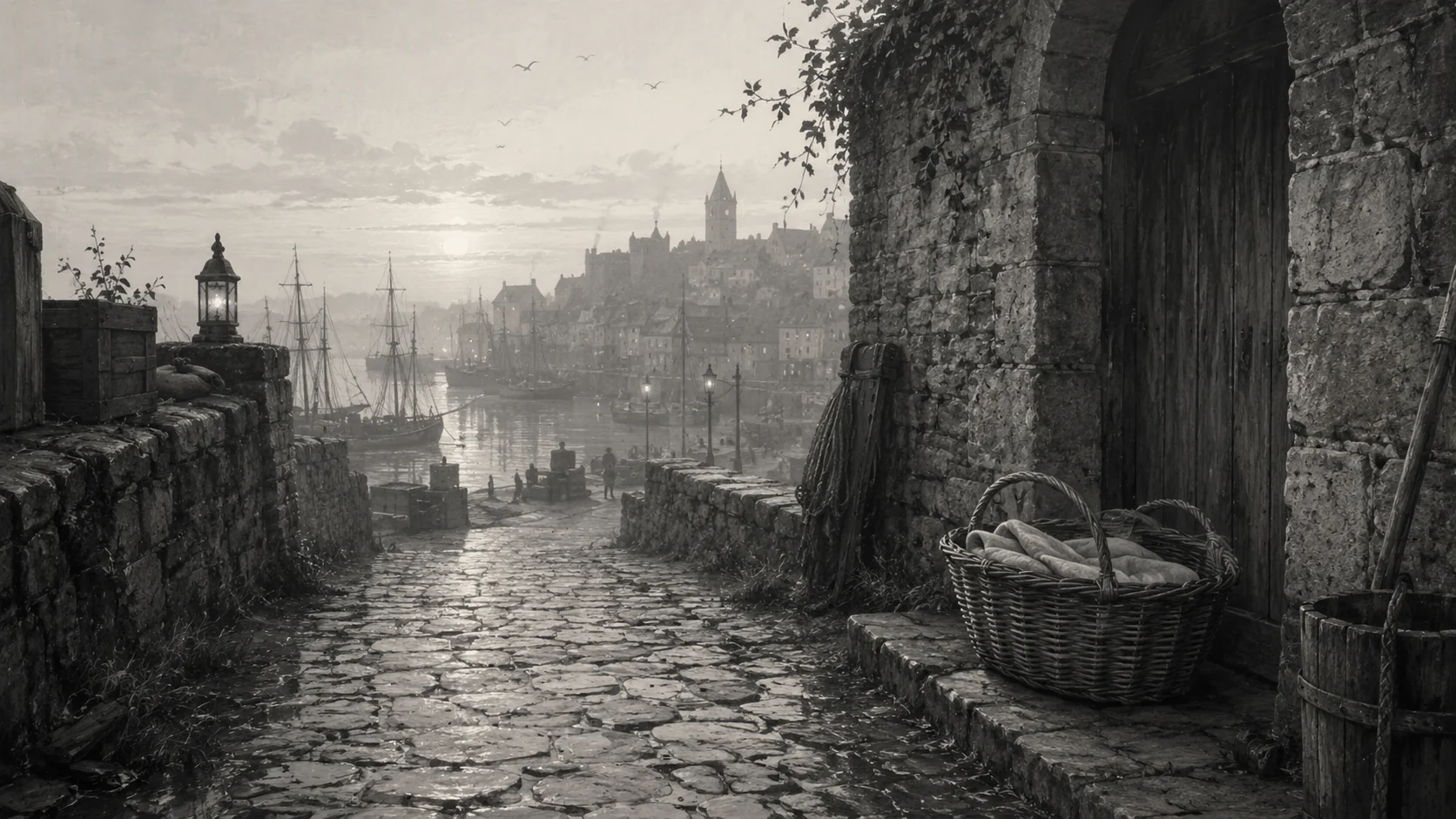
Theo came to Avelos House in a willow basket, though Bram insisted came gave the infant too much credit.
“Arrived,” Bram said whenever the story was told. “You were luggage with opinions.”
At six, Theo objected to both nouns.
He was sitting at the breakfast table with a school registration form in front of him, a cup of milk going warm at his elbow, and the discovery that his lawful name occupied nearly twice as much paper as anyone had warned him.
The clerk had written it in a careful hand across the top line.
THEODOROS AVELOS
Theo stared at it.
Corin, who was eight and therefore considered himself experienced in government, leaned over his shoulder. “It looks expensive.”
“It looks like somebody sneezed halfway through Theo.”
“Your name existed before your complaint.”
“That does not make it well designed.”
Across the table, Tessa was four and had decided the ink needed testing. She pressed one finger against the still-damp final s.
Maren caught her wrist before she could drag it through the whole surname.
“Leave your brother’s legal identity where the clerk put it.”
Tessa withdrew her hand. “Why does he have two names?”
“I don’t,” Theo said. “I have one name and an administrative problem.”
Alden lowered the harbor notice he had been reading.
“That sentence proves you belong here regardless of paperwork.”
Bram placed toast on the table. “The city will be relieved.”
Theo had always been Theo. Theo, shoes. Theo, supper. Theo, if you tune one more string after bedtime I will personally introduce the lute to the attic. The longer name appeared only on documents, on the brass plate inside the family registry, and in his mother’s voice when a situation had become sufficiently serious to deserve all four syllables.
The form bothered him anyway.
“Why Theodoros?” he asked.
Alden and Maren looked at each other.
Not the secret look Theo had recently begun to suspect adults used when they were deciding whether children could survive knowledge. This one was older and easier. They had answered the question before he had learned to ask it.
Maren pushed the registration form back toward him. “Because you arrived without a name.”
Theo knew that part.
He knew he had been adopted in the same way he knew Corin had broken his left arm at five and Tessa had been born during a rainstorm that flooded the herb garden. Nobody had revealed it to him. It belonged to the household’s ordinary inventory of facts.
He did not know the rest.
“What did you call me before?”
“Mostly the baby,” Alden said.
“For three days,” Maren corrected.
“Two and a half.”
Bram set down the butter knife. “For the first six hours, I called you sir, because you objected to every practical suggestion I made.”
Theo narrowed his eyes. “You found me.”
“I have confessed to this repeatedly.”
The story began before dawn, behind the house, on the old service path that ran between the kitchen garden and the storage sheds.
Theo had heard pieces of it all his life. Bram found the basket. Maren warmed the baby. Alden went for the registry clerk. No mysterious traveler returned. No shipwrecked aunt appeared at the gate. Ninety days passed, and the city stopped calling his presence provisional.
At six, he wanted details.
“What kind of basket?”
“Willow,” Bram said.
“Good willow?”
Bram considered. “Serviceable.”
“Was I crying?”
“No.”
Theo looked offended.
“You began once I brought you inside.”
“Why?”
“You were cold. Then you were warm. Warmth apparently gave you energy for criticism.”
Maren smiled into her tea.
Bram had been checking the rear gate after a delivery cart left a wheel rut in the service path. The morning was gray, the harbor bells had not yet sounded first watch, and the basket sat just beyond the garden wall where anyone using the path would see it.
No note.
No money.
No family seal.
No name.
Only a newborn wrapped in a cream-colored cloth too fine for a dockworker’s blanket and too plain for any merchant house Bram recognized.
“You had one fist outside the blanket,” Bram said. “The rest of you had been arranged competently.”
“By who?”
“We don’t know.”
Theo already understood that answer. It had never frightened him as much as adults seemed to expect.
“Did you look?”
“Immediately.”
Alden folded the harbor notice and joined the story.
The city registry sent notices to Ternwick’s midwives, neighboring ports, the watch, shipmasters who had reported passengers missing, and two inland districts connected by the north road. Maren asked the Relief Fund’s contacts whether any family had lost a child during travel. Alden checked harbor arrivals. Bram remembered every stranger who had used the service lane for a month and found none useful.
“No one came?” Theo asked.
“No one with a claim the registry could verify,” Maren said.
The words were careful without being sad.
“What if someone came now?”
Corin stopped chewing.
Tessa looked from Theo to their mother.
Maren did not answer quickly. Theo appreciated that about her even then. She treated questions as if the person asking had actually requested an answer.
“Someone could tell us something true about where you were born,” she said. “Or who carried you here. Or who your first family was. We would listen.”
“And then?”
“You would still be our son.”
Alden’s answer came before Theo could ask the rest.
“The adoption is permanent,” he said. “But more importantly, so are we.”
Theo looked down at the form.
The clerk had written adopted child in a narrow box beside his name. Corin’s old school form, kept under the same blotter because Maren never discarded a document that might one day become somebody else’s problem, said natural child.
Theo knew what both phrases meant.
He disliked that the boxes looked as if they described different amounts of family.
“Who named me?” he asked.
“We did,” Maren said.
That surprised him more than the basket ever had.
She rose and crossed to the small library cabinet beside the dining room. From the second shelf she took a narrow book bound in cracked green leather.
“The registry required a temporary name for the notices,” she said. “Your father suggested Alden.”
“Efficient,” Alden said.
“Vain,” Corin said.
“Traditional.”
“Vain traditionally.”
Maren opened the book.
It was an old coast-name register, the kind charter families used mostly to settle arguments about spelling. Some names had modern meanings printed beside them. Others carried older roots from languages no longer spoken in Ternwick except by scholars, priests, and musicians who liked announcing the age of songs.
Her finger stopped at a line Theo could barely read.
Theodoros — old Hellenic: theos, God; doron, gift. Gift of God.
Theo read it twice.
Then he looked at his parents.
“That is too much name.”
Alden laughed first.
Maren closed the book. “That was also my concern.”
“Then why?”
“Because you had been left somewhere strangers would find you quickly. You were clean. Wrapped well. Fed recently. Whoever brought you to us had made choices.”
Theo waited.
“At the time,” she said, “I did not know whether those choices were desperate, brave, foolish, loving, or all four. I knew only that somebody had placed something precious in our hands and trusted the world not to ruin it before morning.”
Corin made a face. “You realize he is going to quote that whenever he wants dessert.”
“I am considering it already,” Theo said.
Maren touched the school form. “The meaning mattered to me. The grandeur did not have to matter to you.”
Theo tried the full name under his breath.
“The-o-do-ros.”
Four beats. It sounded ceremonial. Like a person expected to enter a hall after a trumpet.
“Theo is better.”
“You have always been Theo,” Alden said.
“I am making it official.”
“On the form?”
Theo took the pen.
The school clerk had left a line marked common name beneath the legal one. Theo printed four letters with the concentration of a treaty signer.
THEO
“There.”
Tessa leaned over. “Can I put Tess?”
“When you are registering for school.”
“I am four.”
“Then prepare.”
Bram cleared the plates.
“Before you declare independence from your remaining syllables, there is another matter.”
He nodded toward the attic stairs.
The blanket came down in a cedar box.
Maren unwrapped it on the dining table. Cream-colored, fine, almost weightless. The weave looked plain until Theo moved around it, when a border appeared in the light and vanished again. It did not resemble the wool blankets in the Relief Fund stores or the linen sheets Bram bought by the bolt.
“The registry called it linen,” Alden said.
“It is not linen,” Maren said.
“You have been arguing with that sentence for six years.”
“The sentence remains wrong.”
Theo touched one corner.
The cloth was cool despite the warm room.
“Did whoever left me make this?”
“We don’t know,” Maren said.
“Was I wearing anything else?”
“A shirt that did not survive you,” Bram said.
Theo smiled.
He studied the blanket a little longer and found that he had no revelation about it. It did not feel like another family. It felt like an object from a morning he could not remember, kept carefully by the people whose mornings he could.
“Can I take it to school?” he asked.
“No,” four voices said.
Tessa said, “I think yes.”
“Five opinions,” Theo said. “A difficult vote.”
Maren folded the blanket back into the cedar box.
“Your teacher needs the form, not evidence that you once fit inside a basket.”
Theo looked at the two names at the top of the page.
Theodoros belonged to the registry, to meanings older than anyone at breakfast, to a choice his parents had made before they knew whether he would grow into it.
Theo belonged to being called from the garden, corrected by Bram, interrupted by Corin, climbed on by Tessa, and kissed goodnight by Maren after she had used the longer name to inform him he was in trouble.
He could live with both.
He simply preferred one.
At the schoolhouse that afternoon, the teacher read the register aloud.
“Theodoros Avelos?”
Theo raised his hand.
“Theo,” he said.
The teacher marked something beside the name. “Theo, then.”
It was the first decision he remembered making about who he was.
It was small enough to fit in four letters.