
Bardo · The Oath
Chapter 1
The Selection
Theo Avelos enters the Guard assessment certain he can help anyone, then learns how one brave choice can endanger an entire team.
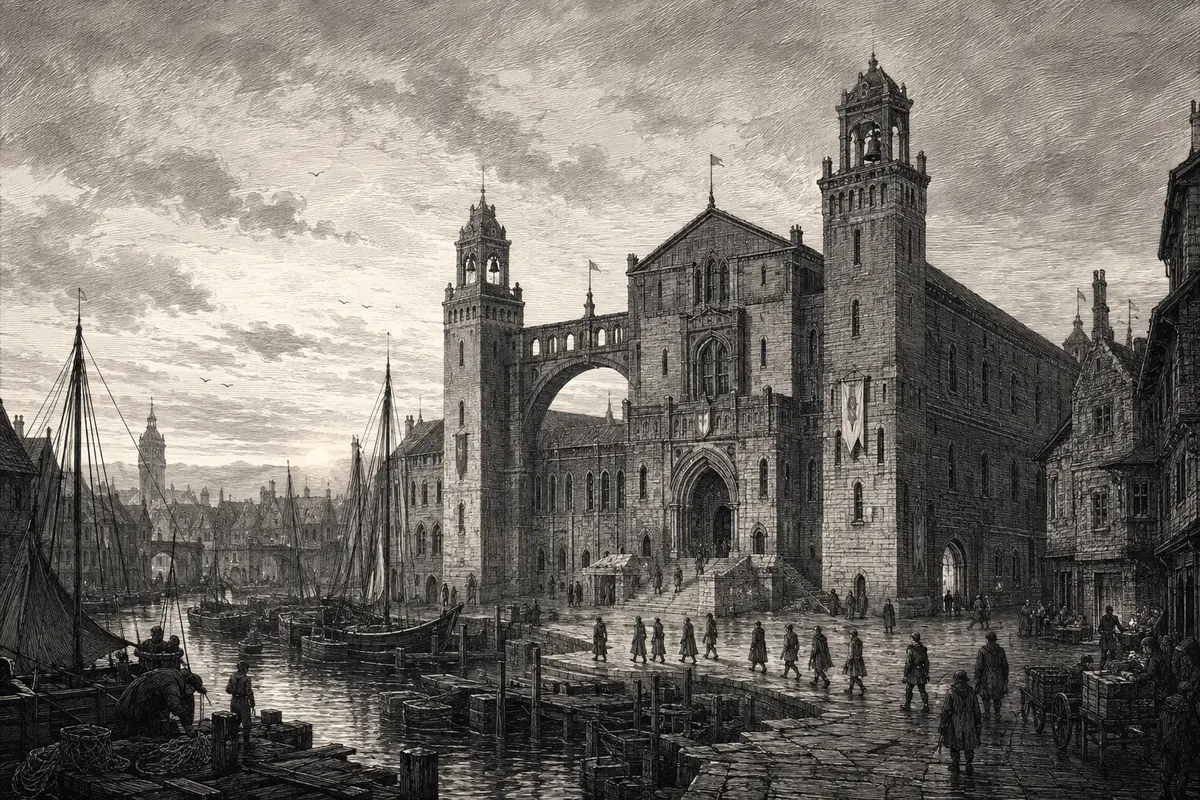
Theo lost the Charter Guard in the time it took a red flag to fall.
It dropped from the assessment tower at the far end of the field, a square of dyed wool vanishing behind the smoke. The signal meant the eastern lane had lost its runner. Theo saw it, raised his baton, and struck the brass plate at his station twice: reserve route, eastern relay. Across the grounds, Candidate Pell turned toward him. Good. Pell had seen.
Then somebody screamed behind the smoke.
Not one of the orderly shouts the assessors had used all morning—Water team ready. South bridge closed. Send four stretchers. This voice tore on the second syllable and ended in a wet cough.
Theo kept the baton raised.
Pell waited for the rest of the signal.
The assessment grounds covered six terraced acres behind North Coast Command. Canvas buildings stood in for a flooded town. Smoke pots obscured three of the lanes, and assessor teams moved among the candidates with slates, bells, and an enthusiasm for announcing fresh disaster. Theo’s group had begun with thirty wooden casualties, two blocked roads, one broken speaking tube, and instructions to move everyone to the stone assembly yard before the tower bell rang twelve.
He had been assigned communications. He had promised himself he would remain assigned to communications.
The scream came again.
Theo completed the signal to Pell: take the east station, confirm when ready. Pell answered with a white flag. Theo should have turned west, where Candidate Senn was trying to tell him something through a tube clogged with soot.
Instead he looked into the smoke.
A figure lay beneath a collapsed awning thirty paces away. Theo could see one boot and a hand dragging at the dirt. No assessor stood nearby. The nearest candidate was carrying a dummy child toward the yard and had not noticed.
The tower clock showed eleven minutes remaining.
Theo struck the plate once—hold—and ran.
The smoke smelled of wet straw and vinegar. It shortened the world to dirt, canvas, and the hand beneath the awning. Theo dropped his baton, knelt, and found a young woman pinned under the crossbar. She wore candidate gray. Blood covered the side of her face.
“Can you move your feet?” he asked.
“I can’t breathe.”
The bar lay across her back. One upright had split; the other leaned toward a brazier used to heat smoke pots. Theo tested the weight. It shifted enough to make the canvas roof sag.
“What’s your name?”
“Lysa.”
“All right, Lysa. I’m Theo. I’m going to lift on three. You’re going to crawl toward my voice.”
“Get the assessor.”
“I am the quicker option.”
He said it lightly, because people breathed better when they had someone else’s confidence to borrow. He planted his boots, counted, and lifted.
The bar rose a handspan. Lysa dragged herself forward. The damaged upright slipped toward the brazier.
“Again,” Theo said through his teeth.
She moved. He kicked the brazier aside before it could catch the canvas, then let the beam fall. Lysa rolled onto her back. The blood on her temple came from a shallow cut, but her breaths were short and fast.
Theo put two fingers against her wrist. He knew enough Relief Fund first aid to distrust a calm face and enough music to count without showing he counted. Fast pulse. No obvious break. Her left hand clutched her ribs.
“Can you sit?”
“You left your post.”
Her voice had changed. Clear now. Almost apologetic.
The tower bell rang once.
Not twelve. Failure.
All across the grounds, candidates stopped.
The smoke pots were capped. Canvas flaps opened. Assessors stepped from alleys and false doorways, suddenly plentiful. Two medics reached Lysa. She accepted one hand and stood without difficulty.
Stage blood ran from the cut at her hairline.
Theo looked toward his station. Pell stood there holding the red and white flags in the same hand. Senn had abandoned the speaking tube. On the western terrace, three candidates argued beside a cart loaded with wooden casualties. The assembly yard gate was shut.
Chief Assessor Vale approached through the clearing smoke. “Candidate Avelos. Where is your baton?”
Theo saw it lying near the fallen awning.
“On the ground, sir.”
“Your post?”
“Unmanned.”
“Your eastern relay?”
“Candidate Pell took it.”
Pell’s face made that answer feel cheap.
Vale marked his slate. “Candidate Pell received no route designation after assuming the station. The east team sent six casualties to a closed bridge. Candidate Senn could not report the west fire. The assembly officer, lacking confirmation that the eastern lane was clear, shut the yard gate. Twenty-one casualties arrived. The exercise required twenty-six.”
Theo glanced at Lysa. “Was she counted among them?”
“No.”
“Then twenty-two people arrived.”
The assessor’s pencil stopped.
It was the sort of correction Theo was good at making: accurate, fair, and badly timed.
Vale finished the mark. “Report to review room four.”
An hour earlier, Theo had liked review rooms.
They were narrow stone chambers with a table, two chairs, and no decorative purpose. A candidate entered, answered questions, and left with a cleaner understanding of where he stood. Theo appreciated places designed around an honest exchange.
Now he sat alone while afternoon light moved across a blank wall. Somebody had taken the stage blood off his cuff but left a rust-colored shadow in the seam.
He replayed the field.
He should have sent Senn before he ran. He should have thrown the hold signal west as well as east. He could have used the speaking tube to call an assessor.
The last thought angered him. Lysa had said she could not breathe. If the injury had been real, the difference between a nearby hand and a summoned one might have mattered.
The door opened. Commander Joanna Mercer entered carrying no slate.
Theo stood so quickly his chair struck the wall.
He had known Joanna most of his life in the way Ternwick knew its harbor bell: not intimately, but by consequence. At Lantern Quay she had carried Tessa out of smoke with one arm and held a roof brace with the other until dockworkers reached them. In the years after, she had become the officer Theo measured other officers against. He had expected to meet her at North Coast Command if he passed. He had not expected her to conduct the failure review.
“Sit,” she said.
Her uniform fit the Guard ideal without looking arranged for it. Charcoal-blue coat, white bridge arch at the collar, silver command bars. There was a pale burn mark along the base of her right thumb. Theo remembered that hand closing around Tessa’s wrist.
Joanna took the other chair. “Why did you leave your post?”
“Candidate Lysa appeared to be in immediate danger.”
“Why did you believe the danger was immediate?”
“She was pinned under a crossbar beside a lit brazier. She reported difficulty breathing.”
“Why did you believe you were the right responder?”
“I was nearest.”
“That is an answer about distance.”
Theo held her gaze. “Because waiting might have harmed her.”
“Did leaving harm anyone?”
“The eastern team lost its route.”
“And?”
“Senn couldn’t report the west fire. The assembly officer closed the gate.”
“And?”
He disliked the method. She kept asking for one more consequence, as if responsibility were a rope she expected him to pull from his own mouth.
“Five practice casualties were not evacuated.”
“Four. Lysa made five, and you saved her.”
Theo’s shoulders loosened before he could stop them.
Joanna saw. “That was not praise.”
“I know.”
“Do you?” She leaned back. “You did a brave thing. You did it competently. You kept the awning from catching and checked her breathing before you moved her farther. If the assessment had asked whether Theodoros Avelos would crawl under a falling roof for a stranger, you would have passed.”
“It asked whether I’d let one call for help while I struck a plate.”
“It asked whether twenty-six people could depend on you to perform the work only you were positioned to perform.”
“I could have signaled before I left.”
“Yes.”
The quick agreement took the fight out of his next sentence.
Joanna folded her hands. “Good intentions matter only when discipline makes them reliable.”
“Lantern Quay wasn’t disciplined.”
He had never said that to her. Not in eleven years.
For a moment the review room was full of smoke again—not assessment vinegar, but pitch and burning rope. Theo at nine, shouting the evacuation beat Maud used to count dock songs. Tessa somewhere beyond the broken crane. Jonas Rell braced against a piling with both palms flat while timber that should have fallen held long enough for people to crawl out. Fire running where the weight went. The crowd calling him mage after the Guard put irons on him.
Joanna’s face did not change. “What do you mean?”
“The quay began to fail. Everybody acted. You didn’t wait to be assigned to Tessa.”
“I was assigned to the east rescue line. Your sister was in it.”
Theo had built a private story around that day. In it, Joanna had seen a child and chosen her over command. The fact settled into a different place.
“Jonas Rell held the quay,” he said.
“Part of it.”
“They took him away.”
“This review is about your decision.”
“It is the same decision.”
“No.” Joanna’s voice remained level. “You want it to be, because then the only alternatives are courage and cowardice. They are not.”
Theo looked at the stained seam of his cuff.
“Your signals score was the highest this cycle,” Joanna said. “Your negotiation score was among the highest. Three assessors noted that you listened before offering terms, which is rarer than candidates imagine. You failed because you treated the person you could see as the whole field.”
“She was the part of it I could save.”
“And Pell? Senn? The candidates at the closed gate? You made them pay for the rescue without asking whether they could bear the cost.”
That reached him. Not because it was new, but because he could see Pell still holding both flags.
Theo sat back. The room felt smaller without his argument in it.
“Can I attempt Selection again?”
“Next year, if you meet the field-experience requirement.”
“I met it this year.”
“You met the minimum.” Joanna slid a folded sheet across the table. “The Ternwick Relief Corps needs signal volunteers for winter storms. It is cold work. Most emergencies will be leaking roofs, spoiled grain, and people who refuse evacuation because they distrust the person asking. No badge. Little applause.”
“You prepared this before speaking to me.”
“I prepared two sheets. The other lists the appeal process.”
Theo almost asked to see it. Pride had a rhythm too: a bright first beat, then a silence in which somebody else carried what he had refused.
He took the Relief Corps sheet.
Joanna stood. “Why?”
“Because I intend to pass.”
“That is about you.”
He looked again at the shadow of red in his cuff. “Because next time Pell shouldn’t have to hold both flags.”
Joanna nodded once and left him with the page.
That evening, rain came in from the sea hard enough to flatten the market awnings. Theo walked home through it without opening his coat hood.
Avelos House stood above Ternwick’s western harbor, where the old merchants had built high enough to watch their ships and far enough from the tide to deny they smelled it. Lamps shone in every lower window. The house was comfortable, square, and perpetually full of somebody else’s emergency. His mother ran the Avelos Relief Fund from the east parlor. At any hour it might contain ledgers, blankets, three indignant fishwives, or a family whose roof had become weather.
Tonight it contained his family pretending not to wait.
Corin sat at the long table reading a shipping notice upside down. Tessa had arranged five cups though there were six people in the room. Bram Toller stood by the hearth with a towel.
“Failed,” Theo said.
His father set down a harbor-charter petition. His mother came around the table but stopped before embracing him, giving him room to choose it. Theo stepped into her arms.
Tessa picked up the missing cup from the sideboard. “I said we needed six.”
“You set five,” Corin said.
“I set one aside for the successful candidate. This one is for Theo.”
It was not a good joke. Theo laughed until his breath shook anyway.
They let him tell the story once. His father asked about the assessment design. Corin wanted to know why Pell had not finished the route himself. Tessa said very little. When Theo reached Lysa beneath the awning, she rubbed the inside of her wrist where Joanna had once gripped it through smoke.
His mother read the Relief Corps sheet.
“Winter signals,” she said. “Bram, do we still have the oilskin instrument cover?”
“Top press,” Bram said.
“I haven’t agreed yet,” Theo said.
Everyone looked at the sheet in his mother’s hand.
“I have,” he amended.
Bram gave him the towel. “Then dry your hair before your conviction kills you of a fever.”
Theo took it. Outside, the harbor warning bell began the first count for a hard-night tide. Three low strokes. A pause. Two more.
He knew that pattern. He also knew, now, that knowing it was not enough.
He went upstairs for his lute, then returned to the east parlor to help the Relief Fund answer the weather.