
Bardo · The Oath
Chapter 2
The Oath
Two years after failing Selection, Theo earns the Guard uniform, leaves his loving household, and meets the team that will test his ideals.
On the morning Theo became a Guard, the registry could not agree what he had been wrapped in.
“Linen,” Bram read from the yellowed page.
“It isn’t linen,” Theo’s mother said.
“The page has maintained its position for twenty-one years.”
“The page is wrong.”
Bram considered the problem with the gravity he usually reserved for cracked roof tiles and dishonest grocers. He stood at the foot of the attic stair, spectacles low on his nose, holding the provisional-care record that had begun Theo’s lawful existence. Behind him, cedar chests and winter furniture crowded beneath the sloping roof. Morning light entered through one salt-clouded window.
Theo was due at North Coast Command in ninety minutes.
“The Guard asked for the registry record,” he said. “Not the cloth.”
His mother had already opened the cedar chest.
The blanket lay beneath a layer of tissue, pale as old cream and finer than anything the Avelos household had purchased for itself. Time had not roughened it. The weave seemed simple until Theo looked from an angle, when small changes in the thread made a border appear and disappear.
He had seen it three times in his life: when he was six and first asked why Tessa had a birth ribbon but he had a registry seal; at twelve, when a leak forced Bram to move the chest; and at eighteen, before his first Selection, when his mother offered to tell him every detail again.
The story never changed. Bram had found a basket behind Avelos House before dawn. The infant inside was quiet, cold, and furious once warmed. Alden and Maren reported him to the city instead of hiding him. The registry allowed ninety days of provisional care while notices traveled the coast. No claimant came. On the ninety-first day, Theodoros Avelos became a permanent line in the family record.
There was no secret grief in the telling and no demand that he feel grateful for existing. His parents treated adoption as they treated every lasting obligation: a decision renewed so often it became household weather.
His mother lifted a corner of the blanket. “A linen declaration suggests ordinary household goods. This survived twenty-one years without yellowing.”
“So has Bram,” Theo said.
Bram looked over the spectacles. “I yellowed noticeably in your adolescence.”
Maren smiled, but her thumb continued along the edge of the cloth. “You could take it to Command. Their examiners may know the weave.”
Theo imagined arriving for his oath with a baby blanket and a question about clerical fiber identification. Thomas Kerr—whom he had not yet met but had already decided would be intolerably composed—would probably arrive carrying only weapons and certainty.
“After Candidate Year,” Theo said, “I would like one morning when the Guard learns nothing new about my infancy.”
“A narrow ambition.”
“I have broader ones after breakfast.”
His mother folded the blanket and returned it to the chest. No light flashed. No hidden crest appeared. It remained an old, beautiful object connected to people he did not know and preserved by people he did.
Bram handed Theo the registry paper. “The clerk’s error has waited two decades. It can survive your ceremony.”
They descended.
Every member of the family had found a different task to delay his departure.
His father checked the buckles on Theo’s field case despite having no expertise with Guard equipment. Corin reviewed the harbor packet schedule and discovered three urgent facts Theo needed about boats he would not be taking. Tessa leaned against the front door with his charcoal-blue coat folded over her arms.
“You cannot wear it until Command,” she said when he reached for it.
“Then why are you holding it?”
“To prevent premature authority.”
At nineteen she had become taller than their mother and sharper than both brothers when anyone mistook affection for permission. She gave Theo the coat only after he put on the plain candidate jacket beneath it.
Corin fastened the field case. “If they send you inland, remember that river merchants lie about depth in the opposite direction from harbor captains.”
“One wants you to load more. The other wants you to draw less.”
“You have learned something in this house.”
Their father held out his hand. Theo expected the formal clasp Alden used at charter meetings. Instead his father pulled him close.
“Serve well,” Alden said. “Come home when you can. Those are separate instructions.”
Maren kissed Theo’s forehead. Tessa hugged him hard enough to test the ribs Guard training had bruised all year. Corin waited until last, then pressed a small brass token into Theo’s palm.
It was the size of a half-crown and worn smooth on one side. On the other, someone had scratched the three-low, two-high pattern used to call dockworkers to an evacuation line.
“Lantern Quay?” Theo asked.
Corin nodded. “You kept tapping it on the cellar wall for months. Father had it made so you would stop damaging the plaster.”
“I was nine.”
“You were persistent.”
The token weighed almost nothing. Theo put it in the inner pocket of the coat he was not yet allowed to wear.
Maud Fenwick waited in the music room with his lute across her knees.
“Absolutely not,” Theo said from the doorway. “I have eighty minutes.”
“Then you may fail more efficiently.”
Maud was small, gray-haired, and capable of turning any chair into a position of judgment. She had taught him since the morning, at six, when he ignored a rack of bright short-necked instruments and chose the long-necked lute because a visiting musician’s formal course had shared its bones with a rhythm beaten on fish crates below the window.
She plucked the third paired course. One string answered a fraction low.
“I tuned it.”
“Last night.”
“Strings should remember.”
“People who say that usually mean they do not wish to check.”
Theo sat opposite her and adjusted the peg. The instrument was not ornate. Five paired courses ran along a neck darkened where his hand had traveled thousands of times. Relief Corps weather had marked the soundboard near the lower edge despite Bram’s oilskin cover. Theo liked the mark. It proved the lute had done work.
Maud sounded a harbor signal: four notes, pause, one.
Theo answered.
She changed the last interval.
He followed by instinct, realized too late that the alteration meant a different road condition, and stopped.
“You heard me,” she said.
“Perfectly.”
“And followed.”
“That is often the point of ensemble playing.”
“In music. In signals, another person’s error may be an instruction to correct.”
Theo reset the phrase to its proper interval.
Maud nodded. “Again.”
“I am taking an oath today.”
“Then you can survive four notes.”
He played them. She introduced the error. This time he held the correct line beneath it until the dissonance declared itself.
“Better,” she said.
From Maud, the word had the warmth of an embrace and the dimensions of a grain of rice.
Theo wrapped the lute and stood.
“You are not taking that to the ceremony,” she said.
“Signals and Dispatch encourages instruments.”
“Signals and Dispatch encourages anything audible at a distance. That is not the same as encouraging you.”
He kissed her cheek. She caught his sleeve before he could leave.
“A pattern is a promise,” Maud said. “People place their next beat inside it. Do not change yours because the room is louder than you.”
The words threatened to sound ceremonial. Maud rescued them by adding, “And oil the fourth peg before it cracks.”
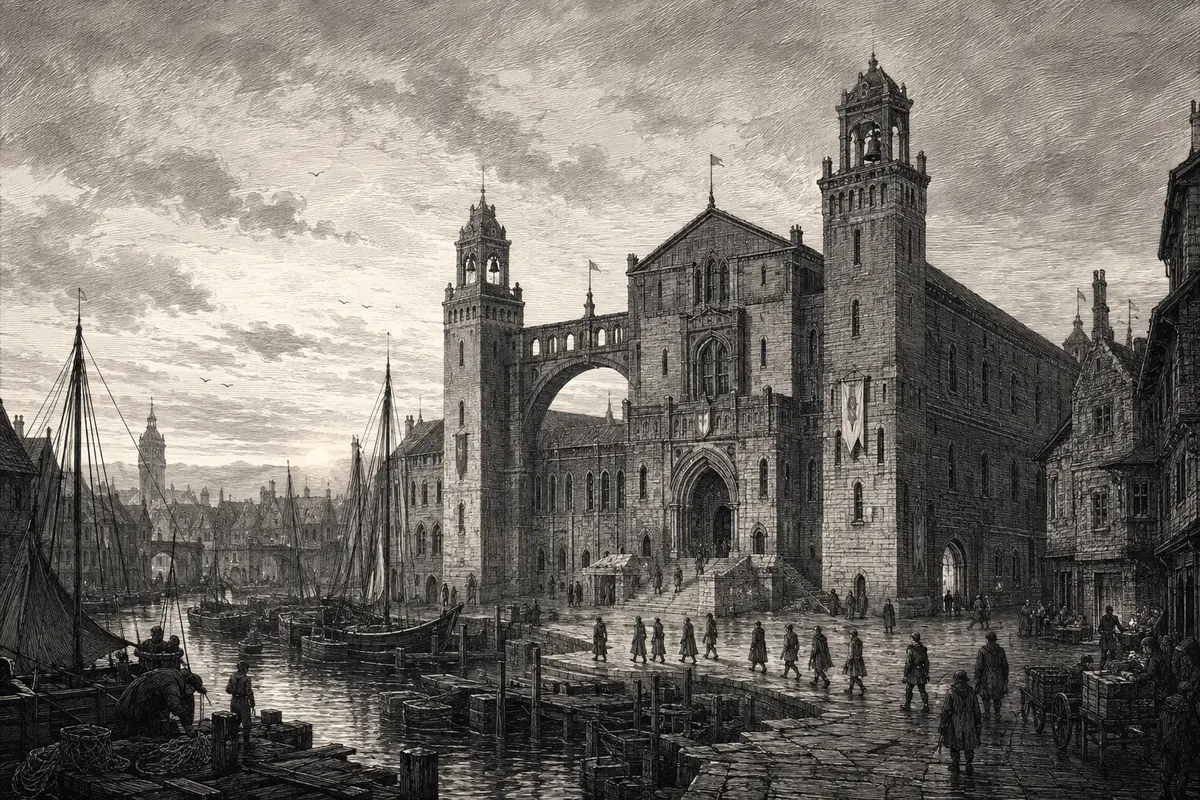
North Coast Command stood on Ternwick’s inland ridge, where the sea remained visible but could no longer put salt on every window. The Charter House occupied the center: pale local stone, a broad stair, and the white bridge arch carved above doors tall enough for banners. Around it clustered infirmary wards, records offices, training courts, stables, dispatch towers, kitchens, and the low dormitories of people who discovered that public heroism required laundry.
Theo arrived with nine minutes to spare.
Candidates crowded the antechamber in fitted charcoal-blue, each carrying a folded outer coat. Some stood alone. Others had families pressed against the cordon. Theo recognized Pell from his failed Selection, now wearing Medical Support green beneath the Guard blue. Pell saw him and raised two fingers: reserve route, eastern relay.
Theo answered with the completed designation.
Pell smiled.
A records officer checked Theo’s registry page, Candidate Year certificate, Relief Corps hours, black-glass screening seal, and name.
“Theodoros Avelos,” she read.
“Theo, unless the full name is required.”
“The oath requires the registered name. Your colleagues may call you whatever makes you answer promptly.” She examined the old provisional-care entry. “Foundling record.”
“Yes.”
“No birth district.”
“The basket failed to complete that field.”
Her mouth moved by half a degree. “Humor has no box on this form.”
“A continuing administrative defect.”
She stamped the page. “Signals and Dispatch, probationer. Assembly line three.”
The ceremony lasted eighteen minutes.
Theo knew because the Charter clock struck the quarter as they entered and because he counted when emotion threatened to make time unreliable.
Commander Mercer stood on the dais beside officers from every branch. She did not look toward him. That helped. This was not a favor given by the woman who had saved his sister or the sponsor who had sent him into two winters of leaking roofs. He had passed the second Selection. He had completed Candidate Year. He had earned his place in the line.
The candidates lifted their right hands.
“State your names,” said the presiding commander.
One by one, they did.
When Theo’s turn came, his full name filled his mouth oddly. “Theodoros Avelos.”
“Speak the Charter oath.”
The hall drew one breath.
“I stand between danger and the unguarded. I will answer the call, keep the road, speak true in my record, and place no rank above the lives entrusted to me.”
Theo had practiced the words until they no longer sounded like language. In the hall they recovered weight. Answer. Keep. Speak. Place. Four actions. No promise that the world would make them agree.
An officer fastened the white bridge arch to his collar. Theo put on his outer coat.
For one dangerous second, he was nine years old again, watching Joanna Mercer emerge from smoke with Tessa in her arms.
Then the person behind him began the oath, and Theo moved forward to make room.
Lieutenant Sabine Holt met Field Unit Twelve beside a supply cage.
She was thirty-five, compact, and still in a field coat darkened by rain at the shoulders. A narrow scar crossed her chin. She held five assignment folders and regarded the new probationers as if someone had delivered equipment in uncertain condition.
“Holt,” she said. “Field command. You will use Lieutenant in public, Holt when speed requires it, and nothing affectionate until evidence supports the risk.”
The broad-shouldered man beside Theo made a small sound that might have been a cough.
Sabine handed him a folder. “Thomas Kerr. Security and extraction. Dual blades, which does not mean twice the judgment.”
Thomas accepted the folder. He was twenty-two, dark-skinned, closely shaven, and carried two swords with none of the swagger Theo associated with people who carried one.
“Nell Arden,” Sabine continued. “Field medicine.”
Nell wore her brown hair cut close at the sides and had already opened her folder. “The supply list is missing splint wire.”
“It is in the second cage.”
“Then the list is missing the second cage.”
“Correct it.”
Nell took a pencil from behind one ear.
“Mira Fenner. Scout and cartography.”
Mira was lean, pale, and examining the drainage along the courtyard wall instead of Sabine. “This map puts the east culvert under the infirmary.”
“It was moved six years ago.”
“The infirmary or the culvert?”
“Find out.”
Mira folded the map with visible approval.
Sabine gave Theo the last folder. “Theodoros Avelos. Signals and Dispatch.”
“Theo.”
“That depends on whether it makes you answer promptly.”
He liked her a little for having heard the records clerk, then realized she could not have. Perhaps bureaucracy had only one joke.
Sabine looked across them. “You are not a family. You are not legends. At present you are five people with complementary paperwork. If you become a unit, it will happen because each of you learns what the others require under pressure.”
Thomas raised a hand.
“No,” Sabine said.
“I haven’t asked.”
“You want to know when we test under pressure.”
“I wanted to know whether the splint wire goes in my pack.”
Nell pointed her pencil at him. “It does now.”
Sabine’s expression did not change, but Theo thought the silence afterward was shorter than it might have been.
A runner crossed the yard and offered her a sealed packet.
She read it once. Then again more slowly.
“Collect field issue,” she said. “We leave at first light.”
Mira looked up from the culvert map. “Where?”
“Dunlow. Three days inland.” Sabine passed the order to Thomas, who handed it along.
Theo read the opening lines over Nell’s shoulder.
Repeated flooding. Damage to the lower mills. Local authority unable to secure the old weir. Witnesses alleged unlawful channel work by an unregistered water mage.
At the bottom, beneath the command seal, someone had added a line in a different hand.
Public fear is elevated. Visible Guard control is advised.
Theo touched the brass token in his inner pocket. Three low strokes. Two high. A pattern people trusted enough to move inside.
He had the coat now. The badge. The lawful name. The work.
Sabine shut the supply cage. “Probationer Avelos, are you listening?”
“Yes, Lieutenant.”
“Good. Start by reading the order no one else received.”
Theo looked down.
The packet in his hand was blank.
Thomas had passed him the cover sheet.
Nell laughed first. Mira followed. Even Sabine allowed the corner of her mouth to move.
Theo handed the sheet back and listened while the real order made its way around the circle.