
Bardo · The Oath
Chapter 14
The Signal Below
Rescue work slows as armed forces close on Derrin and the miners report failing air, forcing command to weigh visible lives against a border war.
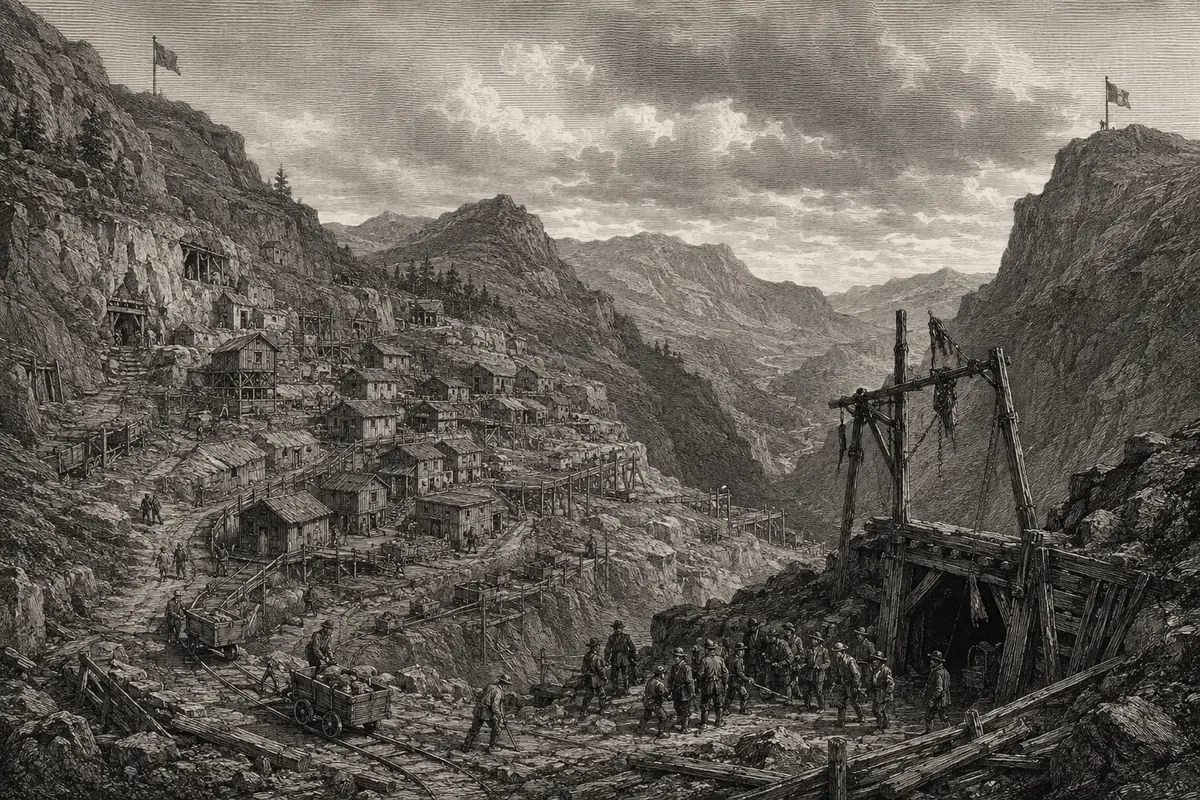
Regional Command granted Unit Twelve ninety minutes.
Sabine had asked for six hours.
The speaking-tube exchange took place in the mine office while rain hissed on the metal roof. Captain Ors, Deputy Seln, and two company engineers waited around the table. Theo stood at the door with the rail log. Through the wall he could hear rescue hammers striking the collapse.
“Ninety minutes preserves active rescue while negotiations continue,” said the command officer at the distant end of the tube.
“Ninety minutes reaches no pocket,” Sabine replied. “The north group is closest to a disputed crosscut. Withdrawal abandons them first.”
“Veyr has advanced an armed company.”
“So has Captain Ors.”
Ors frowned but did not dispute it.
“Guard presence may be interpreted as territorial support,” Command said.
“Guard presence is a rescue operation under Common Charter.”
“Veyr has suspended local Charter recognition.”
“The trapped workers have not.”
Silence moved through the tube, carrying the soft breath of someone deciding at a safe distance.
“Ninety minutes, Lieutenant. Prepare withdrawal. No Guard member enters the north workings. Further advance by either force ends the operation immediately.”
The line clicked closed.
Captain Ors waited until the tube went silent. “My troops can secure the crosscut. We do that, Veyr has nothing to threaten.”
Mira turned one map toward him. “Your secure route crosses their survey line in two places and the Charter lease in one.”
“Your map is not the ground.”
“Then stop trying to die for ink.”
Ors struck the table. “They have moved armed men onto our side.”
“Because the company mined onto theirs,” Sabine said.
Seln objected. Sabine did not raise her voice over him.
“Captain, if you advance, Veyr closes the signal raise. If they close the raise, six workers lose air. Your territorial action kills the people you claim as reason for it.”
Ors looked toward the pit. He had grown up in Derrin; three trapped miners had served in his local levy. His military pride and personal obligation pointed in opposite directions.
“Ninety minutes,” he said. “Then I move if they do.”
“If either force moves, I put the Guard flag between you.”
“With five people?”
“With the treaty both sides signed.”
He almost laughed. Instead he ordered his front rank back ten paces. The agreement bought no peace. It bought the rescue a measurable amount of air.
Theo looked at Sabine. “No rank above the lives entrusted to me.”
Ors and Seln went still.
Sabine turned from the tube. “Do not use the oath as a weapon against me.”
“I am asking what it means.”
“It means those lives remain entrusted to us while I prevent this room from adding a hundred more.”
“They gave us ninety minutes because negotiation matters more to them than miners.”
“They gave us ninety because rifles are loaded on both sides of the ravine.”
“So we leave people who cannot move.”
“We use every minute. Then I decide with the field I have, not the sentence you prefer.”
She took the rail log from him. “Return to Signals. Tell them the rescue continues for ninety minutes.”
“And after?”
“Do not promise.”
The miners below understood the order before Theo explained it.
They heard equipment being repositioned for withdrawal. They heard the change in hammer crews. The shift caller tapped:
YOU LEAVE?
Theo answered:
RESCUE CONTINUES. NINETY MINUTES CONFIRMED. NEGOTIATION ACTIVE.
It was true. It sounded like a clerk standing beside an open grave.
The reply came hard enough to ring the rail.
YOU SAID NOT LEAVE.
Iven could read that much. She turned on Theo before he completed his answer.
“Why did you tell him?”
“I believed we would stay.”
“Did your commander?”
“Rescue was authorized.”
“That is not what I asked.”
Theo had no defense that did not use Tomas’s fear to excuse his own need to answer it.
“No,” he said. “She told me not to promise beyond what we knew.”
Iven looked at Sabine across the site, then back at Theo. “He will spend air believing you.”
The consequence had begun before withdrawal. Tomas might keep working past safety because Theo placed Guard certainty inside the rail.
“Tell him to follow the shift caller’s air limits, not my promise,” Theo said.
“You tell him.”
He did. The message required more blows than we stay. Truth often did.
Theo closed his eyes.
Families could not read the work code, but they heard the anger.
He tapped:
I SAID. I AM HERE.
Sabine had forbidden a promise, not confession.
The shift caller answered after a long wait.
AIR BAD.
The mine physician attempted to estimate survival time from the surface and gave three answers in ten minutes. The main pocket had lamp flames, exertion, unknown fissures, and eleven breathing people. The north six had the open raise but stood nearer the crosscut. Carbon smoke from a damaged lamp could matter more than the size of either chamber.
Nell refused a single clock.
“Give me signs,” she told Theo. “Headache. Confusion. Fast breathing. Whether anyone becomes cheerful without reason.”
“Cheerful?”
“Bad air sometimes makes people feel better before it makes them useless.”
Theo sent the questions. Tomas reported one miner vomiting, two with headaches, no confusion. The north group reported Lio laughing and unable to complete a code.
His mother saw Theo’s face. “What?”
“They are moving him toward the raise. Air hose is going down.”
“What?”
He told her the truth without the medical name. Her hands tightened around the family register until the paper bent.
Nell took the rail hammer and sent a simple physical sequence below: lie Lio down; cover his lamp; do not let him climb unassisted; make him repeat his own name and age. She included both ages from the contradictory records.
The answer returned after a long delay.
SAYS FIFTEEN. TELLS COMPANY EIGHTEEN.
His mother gave one broken laugh. “Still lying for wages.”
That detail made the boy present to every person at the rail. Even Seln stopped calling the roster illustrative.
Nell came at once. Through questions, they learned the main pocket’s ventilation had weakened. The fan line from the surface still turned, but air was escaping through the north crosscut. The separated six had less flow. One worker was already confused.
Mira studied the mine plan. “If the old signal raise is open, we could drop an air hose from the border slope.”
Seln said, “The raise was sealed.”
“Your maps call many open things sealed.”
The company engineer traced the line. “Surface mouth is thirty yards beyond Ors’s post.”
“Still our side,” Ors said.
“Disputed,” Seln corrected automatically.
Mira took Thomas and two mine workers to find it. Sabine kept the main crew cutting toward the eleven. Nell prepared stimulant salts and instructions for the confused miner. Theo counted air, progress, and the shrinking permission clock.
At fifty-three minutes, Mira signaled that the raise was open.
She and Thomas had found it beneath a storage shed built across the old boundary mark. The shed contained blasting powder in crates labeled as drainage tools. Mira sent one crate number back with the hose request.
Seln read it and went pale.
“Production quotas,” Sabine said. “How much unfiled blasting?”
“This is not the time.”
“It became the time when your supports fell.”
Captain Ors ordered the company clerk detained for records preservation. Across the ravine, Veyr soldiers interpreted the arrest as evidence suppression and moved another squad toward the customs house.
Opposition did not wait for the rescue to finish. Every fact acquired a military use before the mud dried.
At sixty-one, they lowered the hose.
At sixty-eight, the north group reported airflow.
At seventy-two, a Veyr patrol moved toward the slope.
Captain Ors deployed his soldiers to meet them.
Sabine ran from the pit to the ravine. Theo could hear the negotiation in shouted fragments: rescue equipment, boundary violation, withdraw the patrol, withdraw the hose. Neither side wanted to fire first. Both had prepared explanations for why the other had.
At eighty minutes, Thomas returned from the raise. “Veyr gives us ten to remove equipment.”
“Command gave us ten,” Theo said. “Veyr did nothing.”
“Veyr has rifles on Mira.”
Thomas’s voice contained no political argument. Only the fact.
“How far to the main pocket?” Theo asked.
“Thirty feet. Bad stone.”
“If everyone stays?”
“An hour. Maybe two.”
The shift caller tapped again.
TOMAS WIFE THERE?
Theo looked toward the woman beyond the cordon. She stood with both hands around the rail, feeling the words she could not read.
He answered yes.
TELL SORRY.
The woman saw Theo’s face. “What did he say?”
He could not protect her with silence. He told her.
She seized his coat. “No. You tell him I’m waiting. You tell him he has nothing to be sorry for.”
Theo struck the message.
Below, Tomas replied:
HEARD.
Sabine returned at eighty-seven minutes.
“Withdrawal,” she ordered.
The mine crews stopped.
Nobody moved at first. The hammers had taught the pit a rhythm all day. Their absence was louder than work.
Sabine stepped to the rail and took Theo’s hammer.
She tapped in plain count, slow enough for every pocket to understand.
SURFACE FORCES REQUIRE WITHDRAWAL. AIR HOSE REMAINS. MARK POSITIONS. SAVE LIGHT. GUARD RECORDS ALL NAMES.
The reply came from the main pocket.
WILL YOU RETURN?
Sabine held the hammer.
Theo watched her choose the exact boundary of truth.
IF AUTHORITY ALLOWS, GUARD RETURNS. OTHER RESCUERS HAVE LOCATION.
The rail stayed silent.
Then the north group sent two words.
AIR FAILING.
The permission clock ended.