
Bardo · The Oath
Chapter 21
The Delegation
Months after Morrow Bend, Theo sees the unidentified woman enter Charter House under another name and an authority no Examiner admitted.
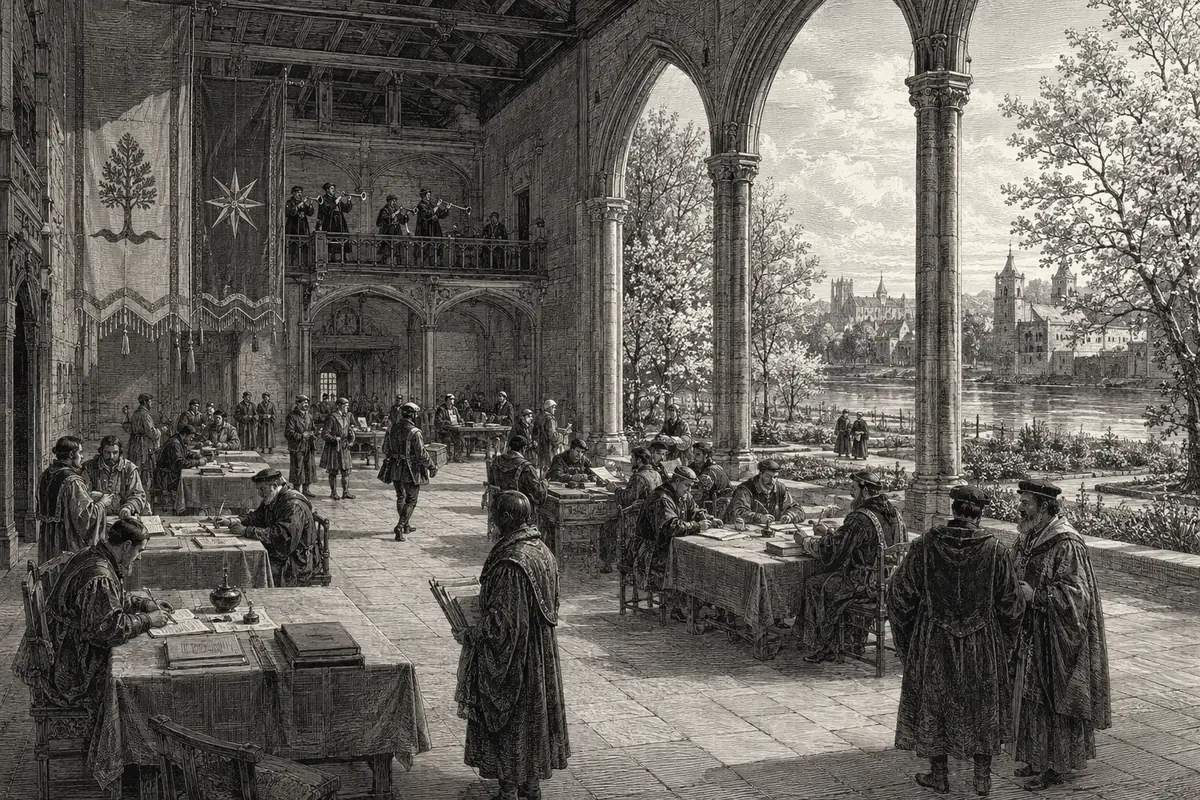
By spring, Theo could carry his lute without Thomas counting the distance.
The ribs had healed. The headaches came twice a week instead of every morning. Tinnitus remained as a thin left-hand note most noticeable in quiet rooms. The tremor appeared when he was tired, angry, or trying to prove it had gone.
Nell called this progress and forbade him to call it recovery.
His field-discretion restriction expired after he passed command assessment a second time. Sabine restored him to ordinary probationary duty but kept him in Signals and Dispatch at Charter House while Unit Twelve rotated through short regional missions. He hated missing the road. He also learned the central signal board, diplomatic routing, medical calls, supply codes, and the names of clerks who could locate a lost message faster than officers who had misplaced it.
Rusk’s tests arrived disguised as work.
A maintenance request asked Theo to inspect a relay bell built on the same bracket pattern as Morrow Bend. He brought a senior signalwright and documented the inspection. Nothing moved except under their tools.
A training memorandum requested his opinion on whether violent wind could redirect a falling support. Theo answered with load tables and stated where he lacked expertise.
Once, a woman matching the witness description crossed the dispatch floor carrying a Special Inquiry file. Dark hair, pointed ears, gray cloak, fine cuffs. Theo looked, recognized a clerk he had seen twice before, and continued routing messages. A black-glass officer at the far desk noted the duration of his glance.
Theo told Sabine about each event.
“Do we complain?” he asked after the third.
“On what ground?”
“Manipulation.”
“Training bells require inspection. Memoranda request opinions. Clerks cross floors.”
“You think they are coincidences?”
“No. I think a complaint would tell Rusk which tests you recognized.”
She moved his next duty assignment from the private annex to the public board. Protection through procedure, quiet as pressure behind a wall.
Good work continued around the sealed door.
The Guard repaired East Road. Dunlow’s lower stores received replacement grain. Hume Holdings appealed its fine. The Derrin review found unsafe production quotas and “shared escalation failures” without naming a single person who had ordered workers below. Two more miners were recovered alive; Tomas was not among them.
Evan’s letters remained undelivered.
Rusk requested one medical update, two clarifications about the signal-house dimensions, and no further interview. The quiet felt designed.
Unit Twelve returned from a six-day river escort on the evening before the delegation notice. Theo heard their arrival through the central board: west-gate entry, medical clearance, equipment loss, one civilian complaint. He knew the sequence well enough to picture them before Thomas crossed the dispatch floor with mud to his knees and a split running through one boot.
“Ordinary probationary duty,” Thomas said, setting a sealed route packet on Theo’s counter. “You would have hated it.”
“How many boats?”
“Nine.”
“How many ropes failed?”
“Three.”
“How many people ignored Nell?”
Thomas considered. “Do you want individuals or events?”
Nell arrived behind him carrying the missing portion of the boot. “He jumped between barges after I told him the gap was widening.”
“The child had fallen.”
“The child was secured to a deck line.”
“A fact I established after jumping.”
Mira placed the complaint beside the route packet. “The barge owner objects that Sabine commandeered his cargo tarps.”
Sabine followed at the pace of someone who had spent six days making other people’s emergencies proceed in order. “The cargo was river stones.”
Theo broke the packet seal under their observation and entered the mission return. Five forms requested the same arrival time in different boxes. One requested whether the unit had encountered a dangerous manifestation. He marked no and felt all four of them notice the care with which he formed the word.
Their work had continued without him. That should have been obvious. It was also newly painful.
Mira passed him a private route addition. The temporary red notch was gone from her access token.
“Restored?” he asked.
“After Sabine attached our findings to the quarterly file.”
“Did Joanna review them?”
“She signed receipt. Special Inquiry classified the answer.”
The institution had acknowledged the missing people by restricting the explanation for why they were missing.
Sabine saw his expression. “Record the return in front of you, Avelos.”
He did. Equipment loss, civilian complaint, medical clearance. The river escort had ended with every passenger alive. That fact did not become less true because another file remained sealed.
When he finished, Thomas took back the packet.
“You could ask how the child is,” Thomas said.
Theo looked up.
“How is the child?”
“Angry that we made him wear a second line.” Thomas’s face softened. “You would have liked him.”
Theo wanted to say he should have been there. Instead he said, “Tell me how the first rope failed.”
The unit remained around the counter while Thomas demonstrated with a dispatch cord, Nell corrected the angle of his hands, and Mira drew the current that none of them could see from the barge. Theo entered two lessons into the signal manual before they left.
Missing the road had not made him useless. Being useful did not mean he had stopped missing it.
Then Lorness announced a royal delegation.
Charter House spent six days becoming ceremonial.
White bridge banners were washed and rehung. Bronze braziers appeared from storage. Every signal runner learned the Lorness precedence calls, which used a descending horn pattern liable to be mistaken for fire response if played too quickly. Theo rewrote the timing and made the ceremonial musicians practice beside an actual alarm bell until nobody confused admiration with evacuation.
On the morning of arrival, Sabine inspected his uniform.
“Your left collar is higher.”
“My right shoulder is lower.”
“Correct it without philosophy.”
She adjusted the white bridge pin herself.
“You will work the east gallery board,” she said. “No direct delegation contact unless routing requires it.”
“Was I likely to create diplomacy from the west gallery?”
“You create complications from available materials.”
Thomas, assigned ceremonial security, passed behind them in formal coat with both swords peace-bound in white cord.
“He brought enough socks,” he said.
Sabine looked at Theo.
“Four dry pairs,” he said.
“Growth,” she replied, and left.
The delegation entered beneath the Charter arch at noon.
Lorness guards came first in deep green coats fastened with silver branches. Court officers followed, then envoys carrying document cases. They were mostly elven, though not uniformly tall, pale, grave, or any other trait Ternwick tavern songs assigned them. They spoke to one another in low, quick phrases and adjusted to the Guard’s ceremonial pace with visible patience.
Theo watched from the east gallery, one hand on the signal lever.
The herald named Queen Iona’s ministers.
Then the woman from Morrow Bend walked into the hall.
She wore blue and silver, the hidden colors now visible across a formal coat embroidered with leaves and small crowns. Her dark hair was arranged above pointed ears no wet strand concealed. A narrow circlet rested on her brow. The scar at her wrist disappeared beneath a jeweled cuff.
“Her Royal Highness Nerys Selwyn,” the herald announced, “Crown Princess and First Heir of Lorness.”
Theo missed the next signal.
Only half a beat. The western horn entered early. Theo caught the error, held the correct line beneath it, and brought the gallery back together before the descent could resemble an alarm.
Maud would have approved the correction and condemned the lapse.
Nerys looked up.
Across the full height of Charter House, their eyes met.
No recognition touched her face.
Theo lowered the signal lever on count.
The procession continued.
Rusk stood near the dais among Special Inquiry officers.
He was not looking at Nerys.
He was looking at the east gallery.
The public session lasted three hours.
At the central board, Mira served as document-route verifier because Lorness maps used older road names. Thomas stood ceremonial security near the west arch. Nell joined the medical protocol table, where Lorness physicians argued that Guard examiners could not be alone with healers during assessment.
Theo watched the unit affect the room without him. Mira forced both parties to place missing detainees on the same geographic ledger. Nell asked who accepted medical responsibility during transport; nobody from Inquiry volunteered a name. Thomas quietly moved a black-glass officer away from a Lorness page after the officer began an unrecorded conversation.
Sabine coordinated them from the floor.
Field Unit Twelve had not become a family. It had become harder for one office to isolate a person without crossing several kinds of attention.
Lorness sought updated road protections, medical exemptions for diplomatic personnel, and access to Guard records concerning missing citizens. The last request entered the hall disguised as a technical discussion of cross-border custody notices.
Theo routed translation requests and document runners. He heard only fragments.
“—no receiving acknowledgment—”
“—individual assessment remains protected—”
“—families entitled under treaty—”
“—cannot disclose dangerous manifestation findings—”
Nerys spoke twice. Her Charter speech had been careful at Morrow Bend because she was concealing origin under pain. Here it was precise enough to make ambiguity expensive.
“Lorness does not request your methods,” she said. “We request evidence that our people remain alive while subject to them.”
Theo could not see Rusk from the gallery, but he knew exactly how the question would land.
The Guard legal minister answered that survival confirmation might reveal protected facilities. A Lorness envoy asked whether a facility became safer when no court, family, or foreign office could prove who occupied it. The minister called that a mischaracterization. Mira’s document runners carried the disputed word between tables three times.
Nell requested the medical-custody appendix. It arrived with two paragraphs blacked out and no physician’s signature. She returned it with a note: No medical claim can be entered into joint minutes without an accountable clinician.
The minister tried to proceed without it.
Sabine refused the routing call.
From the gallery Theo watched a disagreement become procedure. Thomas held the doors while an unlisted Lorness physician was admitted. Mira inserted the physician’s credentials into both parties’ ledgers. Nell placed the medical question back on the agenda. No speech had done it. Four small refusals had made omission more difficult.
The eventual language required receiving acknowledgment for foreign detainees within thirty days, with a sealed exception reviewed by one medical and one diplomatic officer. It did not free anyone. It did not name Evan. It created two more people whose signatures would have to exist if a person vanished.
Theo entered the adopted clause on the signal record.
Good work, incomplete and expensive. The Guard had taught him how much could fit inside those words.
At recess, a Lorness page brought Theo a routing card.
East archive alcove requires signal inspection before private treaty session. Dispatch requests Probationer Avelos due prior relay-line experience.
The request was ordinary except for one detail: the east archive alcove had no signal line.
Theo checked the authorizing mark. Charter liaison office, valid. No request that he serve as Nerys’s liaison. No name attached.
He showed it to the gallery supervisor.
“Five minutes,” she said. “Take a test bell.”
The east archive corridor stood empty. Theo carried the brass bell past locked cabinets and a row of windows overlooking the inner garden.
Nerys waited in the alcove with one older court officer. The officer examined Theo, then moved to the corridor mouth without leaving hearing distance.
“Your Highness,” Theo said.
“Probationer Avelos.”
They bowed as strangers should.
Up close, she looked less recovered than the hall allowed. Makeup softened a pale line at her temple. Her left hand remained close to her body beneath the formal sleeve.
“There is no signal line here,” Theo said.
“Then your inspection may be brief.”
“Did you arrange this?”
“I arranged for an error to reach the person most likely to correct it.”
“Errors attract records.”
“So does requesting you by name.”
She had considered the field before moving. Theo felt the difference between her method and his own flight toward the signal raise.
“Are you safe?” he asked.
“For the length of this delegation.”
“That is not what I meant.”
“It is what I can answer.”
The court officer glanced down the corridor.
Nerys lowered her voice. “We need to compare what happened at Morrow Bend. Not here. Tomorrow, during the garden circuit. The west orangery is closed for repairs but accessible from the treaty room.”
“Rusk is in the House.”
“I know.”
“He watched me recognize you.”
For the first time, her composure shifted. “Did you?”
“Half a beat.”
“Musicians count smaller failures than investigators.”
“Investigators survive by them.”
Footsteps approached.
Nerys stepped back. “Inspect the imaginary line.”
Theo rang the test bell once against the stone wall, listened, and marked the routing card no installed relay; request filed in error.
Two Guard clerks passed the corridor mouth. They saw a princess waiting, an officer listening to a wall, and a court attendant supervising both.
Every part was true.
Theo bowed and left.
At the east gallery, a message waited beneath his signal board.
Chief Examiner Rusk requested an updated copy of the Morrow Bend witness description.
No urgency. No accusation.
Only a polite note timed to the arrival of the woman Theo had once failed to name.