
Bardo · The Oath
Chapter 23
No
Martin Rusk asks one precise question about the Lorness delegation, and Theo decides what the Guard's oath requires him to withhold.
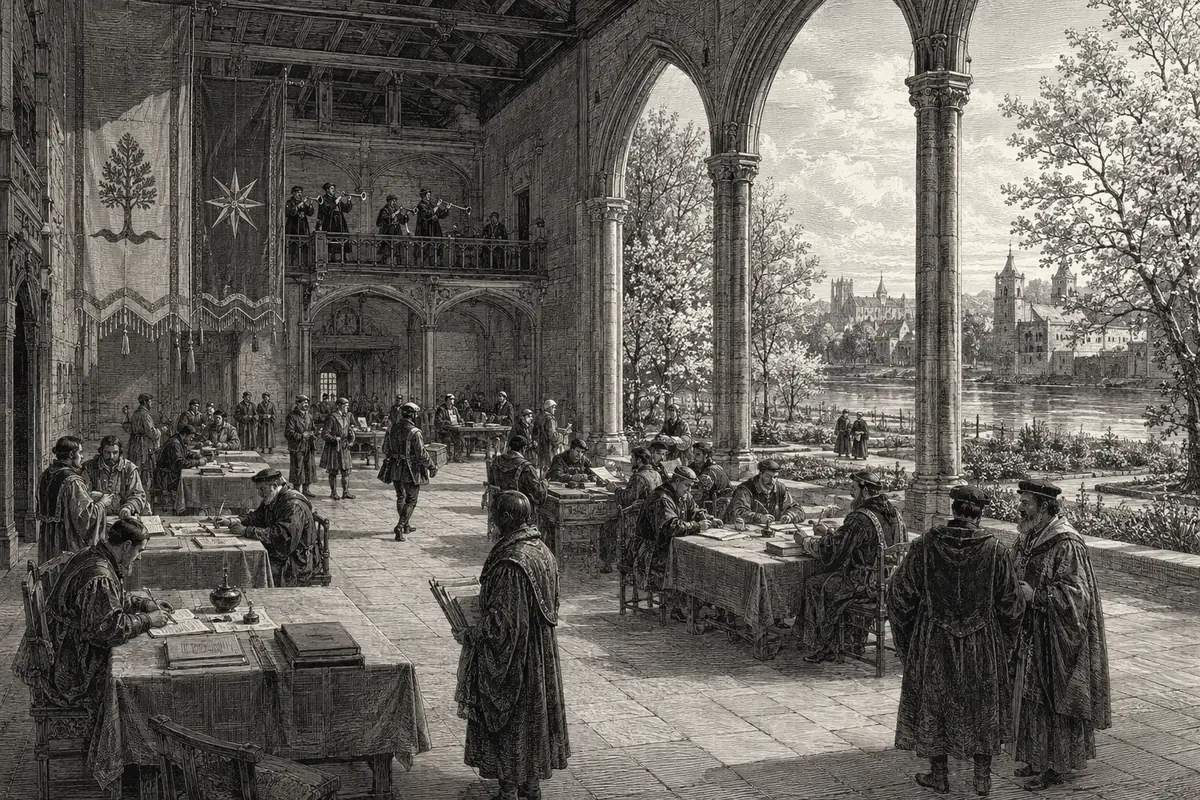
Office Four was close enough to the treaty hall that Theo could hear applause through the wall.
The delegation had concluded its public session. Somewhere beyond the corridor, Lorness and the Charter Guard were praising continued cooperation while arguing over people who had no forwarding address.
Rusk waited at a small table with two cups and no notebook.
“Probationer Avelos,” he said. “How are the ribs?”
“Healed.”
“The headaches?”
“Less frequent.”
“I am glad.”
Theo believed he might be.
He sat. The badge at his collar caught against the edge of the formal coat. He adjusted it without looking down.
Rusk poured tea. “This is a clarification, not a formal interview. You may request Lieutenant Holt.”
“Do I need her?”
“That depends on your answer.”
Courtesy, Theo had learned, could narrow a room more efficiently than threat.
“Ask,” he said.
Rusk placed a single sheet on the table. It contained the Morrow Bend witness description compiled from Theo, the supply driver, and the clinic physician.
Young adult elven woman. Dark hair. Green-gray eyes. Educated Charter speech. Fine concealed embroidery in blue, gold, and silver. Injury at mouth and wrists. Familiarity with protected roads. Possible foreign coin.
No invention. No trick.
Rusk touched the last line. “At the time, you could not identify her.”
“Correct.”
“You had received no name, title, origin, or destination.”
“Correct.”
“You stated she had removed documents from Marr and burned a paper containing names.”
“Yes.”
“You believed she feared further Examiner action.”
“My interpretation.”
“A reasonable one.”
The treaty-hall applause ended. In the quiet, Theo’s left ear supplied its thin note.
Rusk folded his hands. “Today you observed the Lorness delegation.”
“I worked the east gallery signals.”
“Did you see anyone matching this description?”
The question was broader than the one Theo had expected. It gave him room to discuss dozens of dark-haired elves, court embroidery, educated speech.
Room could be another form of test.
“Several delegates share parts of it,” Theo said.
“Of course.” Rusk lifted the sheet. “Description is a poor instrument when isolated. Context improves it.”
He did not mention the missed half-beat. He did not need to.
“Examiner Marr accessed your recruitment screening before traveling north,” Rusk said.
Nerys had told the truth about that.
“Why?” Theo asked.
“Unknown. He reviewed several Guard personnel with exposure to active manifestations.”
“My screening was clear.”
“Entirely.”
“Do you believe I killed him?”
Rusk considered the question. “I believe Marr and Baird died because multiple people exercised poor control in a dangerous room. I believe you entered to protect someone. I believe the unidentified woman used an ability on you. I believe something occurred during the period you cannot recall.”
“That is careful.”
“Care is the point.”
Rusk reached into the thin folder at his elbow and removed another page. He turned it so Theo could read without lifting it.
The report concerned a cooper’s daughter in West Caldrin. Nineteen. First event: heat drawn out of a vat quickly enough to split the iron band. No injuries. Her family and guild had concealed it for seven months. Second event: a winter schoolroom, a failed stove, heat moving in the wrong direction. Eleven children burned before anyone understood what she had done.
The incident summary gave no judgment about intention. It did not need one.
“She was trying to warm them,” Rusk said. “Everyone who hid the first event believed they were protecting her from us.”
Theo read the casualty list. The youngest child had been six.
“What happened to her?”
“Assessment.”
“And after assessment?”
“Protected disposition.”
The old phrases. The horror in the schoolroom did not make the missing destination clean. The missing destination did not unburn the children.
“Is she alive?” Theo asked.
Rusk’s attention sharpened by a degree. “Her status is not relevant to the lesson.”
“It is the lesson.”
“The lesson is that concealment can transfer risk to people who never consented to bear it.”
“And unaccountable custody transfers risk to everyone you take.”
“You have seen bad custody.”
“I have seen records designed to stop.”
“Some records stop because the people who hunt dangerous abilities also read records.”
“Families read them too.”
Rusk did not dispute that. “Every protection selects who receives information. Selection creates risk. There is no arrangement without it.”
Theo looked again at the children’s names. Rusk had not shown him an abstraction. He had shown him the strongest reason for control and left the weakest part of that control behind the same sealed word.
“Did hiding her first event cause the second?” Theo asked.
“It prevented training, containment, and supervision.”
“That isn’t the same answer.”
“It is the answer available.”
What unsettled Theo about Rusk was not certainty alone. Rusk could carry true evidence all the way to a boundary and call the boundary necessity.
Rusk moved the witness sheet between them. “If the woman is attached to a royal delegation, identifying her through ordinary accusation could cause diplomatic harm. Failing to identify a dangerous actor could cause greater harm elsewhere. Mercy without control is negligence. Control without accurate information is theater.”
Theo had wanted Special Inquiry to admit complexity. Now the admission became a hand around Nerys’s route.
“What happens if I identify her?” he asked.
“We verify privately.”
“How?”
“Protected procedure.”
“Will she be detained?”
“Diplomatic status constrains custody.”
“Will her contacts be investigated?”
“If evidence warrants.”
“Will her ability become evidence?”
“If she has one.”
Every answer crossed the bridge and removed a plank behind it.
Theo saw the fields.
Nerys had influenced him. She had admitted it. She had removed evidence and concealed a protected route. She represented a monarchy whose justice he did not know. Her healing could carry risks she had not explained. Trust did not make her harmless.
Rusk represented an office that had erased Evan’s rescue, ended transfer records at district lines, denied its own Examiners, and called the absence protection. Suspicion did not make every person inside it false. Sabine was not false. Joanna was not. The clerks who kept undeliverable letters were not.
Truth remained true.
It was not therefore safe to surrender.
Rusk watched him without impatience.
“Probationer Avelos,” he said, “do you recognize anyone in the Lorness delegation as the unidentified woman from Morrow Bend?”
The oath came to Theo in the exact voice of the hall.
I stand between danger and the unguarded. I will answer the call, keep the road, speak true in my record, and place no rank above the lives entrusted to me.
At nineteen, he had believed the person he could see was the whole field.
At Derrin, he had promised other people into danger because he could not endure being the one who left.
Here, the choice was smaller. No running. No bell. No borrowed hands. He could not command Nerys, her healers, Unit Twelve, or the consequences Rusk might create. He could choose which part was his.
Theo looked at the witness sheet.
“No,” he said.
The lie did not sound different from truth.
Rusk’s face did not change. “No one?”
“No one I recognize as the woman from Morrow Bend.”
The second sentence was worse. It closed the space where accident might have lived.
Rusk drew the sheet back.
“Thank you.”
He did not accuse Theo. He did not reveal evidence from the gallery or the orangery. He poured the remaining tea and asked whether Nell had approved Theo’s return to road duty.
Theo answered carefully. The ordinary questions lasted four minutes.
At the door, Rusk said, “Your oath requires true record.”
Theo turned.
“Yes.”
“It is a difficult promise.”
“All four are.”
Rusk paused before dismissing him. The pause gave Theo nothing he could use.
“Good afternoon, Probationer.”
Theo left.
Charter House had returned to work.
Runners carried treaty copies. Musicians packed ceremonial horns. A cleaner removed flower petals from the stair before someone slipped. The Guard did not darken around Theo’s choice. No bell marked the line he had crossed.
Sabine waited by the east gallery.
“Clarification?” she asked.
“Yes.”
“Resolved?”
Theo felt the lie waiting for company.
He would not give it more than it required.
“Rusk completed his questions,” he said.
Sabine held his gaze. “Did you answer them?”
“Yes.”
True. Incomplete. He understood now how a record could retain every original word and change what the arrangement did.
“Do you need to amend your Morrow statement?” she asked.
This was the exit Rusk had left open through her: confess while the lie was still young, place responsibility back inside command, let Sabine carry the next consequence.
“No,” Theo said.
Sabine’s face gave him no absolution. “Then your statement stands under your name.”
“I know.”
She accepted only that he understood the ownership of it.
Sabine studied him. She could ask for the content. As his commander, she had grounds. Instead she handed him a dispatch strip.
“Medical call at the south gate. Runner line is crowded.”
Theo took it. “Am I assigned?”
“Signals and Dispatch.”
He fastened the strip to his board and sent the call through the nearest open route. The south-gate bell answered. A medical team moved.
Across the hall, Nerys descended with the Lorness delegation. She did not look toward him.
Theo did not need her to.
The badge at his collar weighed exactly what it had that morning. White bridge on charcoal-blue. A promise made visible.
He remained inside it.
He heard the next signal and answered.
That evening, he returned to Avelos House for the first time since the delegation arrived. Maren’s relief parlor held two sailors, a sailmaker with an infected splinter, and a Lorness clerk asking which harbor warehouses could receive medical supplies without exposing them to damp. Theo did not know whether the question belonged to the protected route. He did not ask.
Corin gave him a stack of charter notices to sort. Tessa tuned the fourth course of his lute before he could reach it. Alden argued with a ship owner about emergency berth fees. Bram brought tea and observed that Theo’s uniform required brushing.
No one knew he had lied that afternoon.
The secret did not make him solitary by magic. It made attention necessary. He would have to decide, again and again, what silence protected and what silence merely protected him.
He took up the lute after the parlor emptied. The paired strings answered one another across the soundboard. Theo could hear tension, wood, fingertip, air. Ordinary relationships among forces. He played Maud’s four-note signal and held the correct interval when Tessa deliberately changed hers.
“Better,” she said in Maud’s exact tone.
The word was not forgiveness. It was work continuing.