
Bardo · The Oath
Chapter 6
High Water
When Dunlow's weir begins to fail, Guard and accused mage must work together while the law waits on the far side of survival.
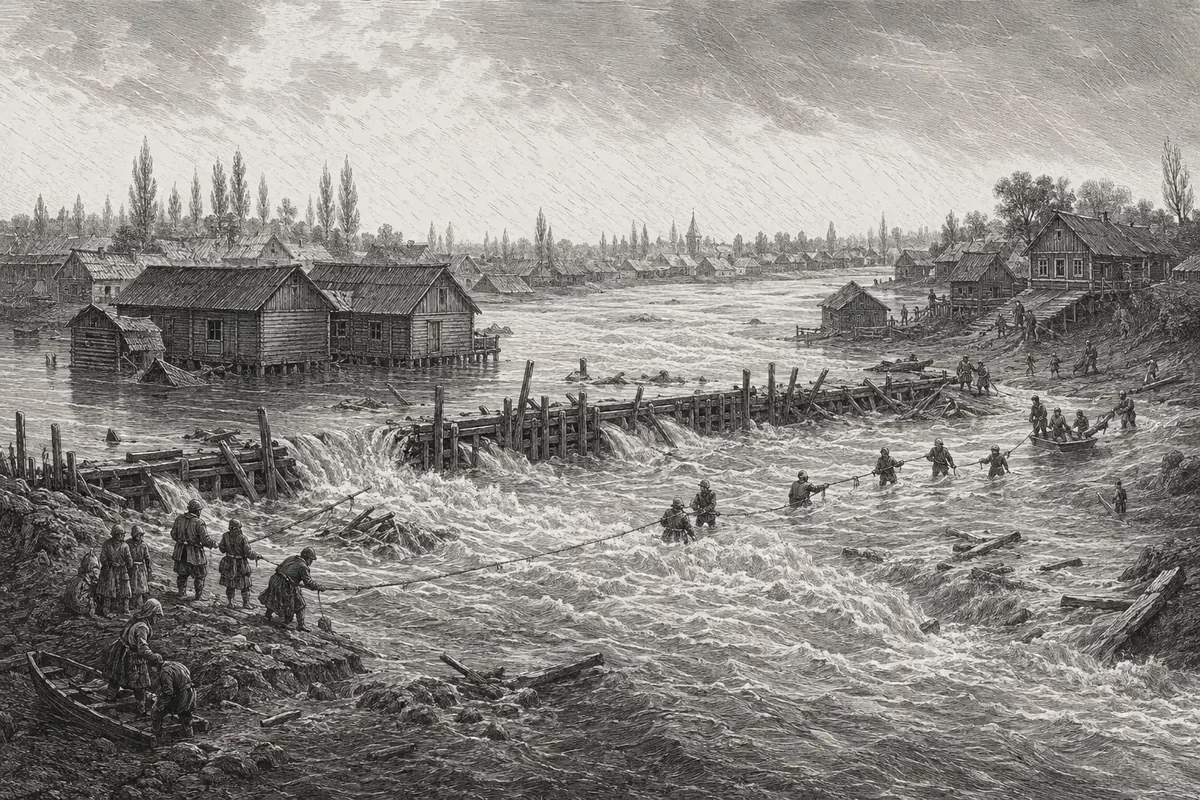
The first flood reached Dunlow before the warning did.
Water broke through the west pasture in a low brown wall, carrying reeds, fence posts, and one section of a footbridge. It struck the mill road behind Unit Twelve and spread across both ditches.
Sabine looked once at the weir, once at the town, and divided the world.
“Mira, high route and breach location. Nell, lower houses. Thomas, get Parn’s watch off the bridge and open the assembly yard. Avelos with me. Evan—”
Evan was already moving toward the water.
“Moss!”
He turned.
“If you run alone, we lose what you know.” Sabine pointed to Theo. “Stay where Signals can find you.”
It was not an arrest command. Evan recognized the difference.
“The south spill has to open,” he said. “All three gates.”
“Who has keys?”
“Hume.”
Sabine blew three sharp notes on her whistle: emergency authority. Thomas echoed from the road. Farther off, the town bell began an uncertain count.
Theo pulled the brass token from his pocket and struck it against the metal spine of his signal board: three low, two high. Evacuation line. The tiny sound vanished in rain.
He struck again, using the board’s hollow back to carry it. A watchman on the bridge heard and repeated the pattern on the railing. Then someone at the first mill took it up with a hammer. Three low. Two high. The count moved toward town.
“South spill,” Sabine said. “Go.”
They ran.
Hume South Mill had barred its yard.
Workers crowded behind the gate while Arlo Venn argued with Warden Parn through the ironwork. Walter Hume himself stood beneath the mill arcade, dry under a broad black umbrella. He was a heavy man with silver hair and a face shaped by years of hearing objections from the far end of a table.
“Opening all spills will ruin the lower grain stores,” he called.
Evan reached the gate. “Keep them shut and the west gate takes the town.”
Hume looked at his muddy clothes and bleeding boot. “You are the reason the pressure is unstable.”
“Your culvert emptied the gate bed.”
“Lieutenant,” Hume said, “remove that man from my property.”
Sabine drew her short field bar from its loop and struck the emergency seal plate beside the gate. “Under Common Charter flood authority, this yard and every connected control are requisitioned until immediate danger passes. Open it.”
“You have no district declaration.”
The ground shook. A mill window cracked from corner to corner.
Sabine struck the plate again, hard enough to dent it. “You have one now.”
Hume made a small motion beneath the umbrella. A clerk ran for the keys.
Thomas arrived with six watchmen and no patience. When the gate opened, he assigned two to each wheelhouse. Nell’s whistle sounded from the lower street: medical assistance needed.
Theo climbed the spill platform. Three iron wheels controlled the gates beneath it. River pressure made the spokes tremble. The left wheel turned half a notch and kicked back.
“They are bound,” a mill engineer said. “Silt or bent rack.”
“Can you open them?” Sabine asked.
“Not together.”
Evan gripped the rail. His face had gone gray.
“The middle first,” he said. “Then south. Leave north until the race clears.”
The engineer shook his head. “Middle discharges toward the workers’ quarter.”
“For thirty yards. Then the old field cut takes it.”
“The field cut is filled,” Theo said.
Evan looked at him. “Not all of it.”
Mira appeared at the foot of the platform, soaked to the skin. “Breach is following the buried bed. Main flow reaches lower street in six minutes. High route is the orchard road. Footbridge is gone.”
Sabine made the decision. “Middle gate. Controlled release. Mira, clear the field cut where it still runs. Thomas, workers’ quarter to orchard road. Nell gets every cart she asks for. Theo, keep the routes speaking.”
Theo tied red and white lantern covers to the platform rail: red for closed, white for passable. Daylight was failing behind the storm. He assigned the mill hammer evacuation rhythm, the town bell high route, and his own whistle to gate timing. Too many sounds could become another kind of silence. He made each one answer a single question.
The engineer and three workers strained at the middle wheel. It did not move.
Evan stepped to the rail. “Again.”
He closed his eyes.
Water hammered somewhere below. Theo could feel it through the platform: chaotic pressure against three gates, mill races, damaged earth. The rhythm changed. Not less force—rearranged force. The left wheel stopped kicking. Beneath them, water roared toward the middle spill.
“Now,” Evan said.
The workers heaved. The wheel turned.
Brown water burst into the workers’ quarter.
Theo blew the gate signal. The mill hammer answered. Down the street, Thomas’s voice drove people uphill.
Evan sagged against the rail.
“What did you do?” Sabine asked.
“Opened a path.”
“Without the wheel.”
“The wheel is open.”
He would not name it. The water had.
For the next hour, Dunlow became a set of decisions made faster than fear.
Theo ran the line between spill platform and lower street. At each intersection he left a person with one signal and made them repeat it before he moved on. A baker struck a pan for clear passage. Two mill children carried white cloth to the orchard turn. The old woman from the lodge stood on a cart beating three-low, two-high with a wooden spoon while her geese screamed beneath a tarp.
Cora Bell refused the orchard road. Her sister was still at South Mill, helping release a gate Hume had ordered shut. Theo found Cora waist-deep beside the worker barracks, tying a rope across the current.
“Evacuation is uphill,” he told her.
“Workers’ dorm has six night men asleep.”
“Thomas is clearing it.”
“Thomas doesn’t know the attic stair sticks.”
She did. Theo changed her from evacuee to local guide, gave her the white route cloth, and sent a watchman with her. The decision violated no plan because the plan improved when people who lived there entered it.
Minutes later, Cora led seven men through the dye yard. One carried payroll books above his head. Another carried nothing but a cage of canaries from the mill’s bad-air station.
Hume’s clerk shouted for the payroll books.
Cora handed them to Mira instead.
“Evidence of who was working which gate,” she said.
The flood had not made residents passive witnesses to Guard competence. It gave them a moment in which the ordinary cost of speaking changed.
Nell converted the cooper’s shop into a triage room. She sent Theo back out with a strip of blue cloth tied around his arm, meaning he could direct walking wounded but not touch anyone marked red.
“I know first aid,” he protested.
“Then you know why I need you elsewhere.”
On the lower street, water rose to his thighs. He used the lute case as a dry box for message slips and hated every impact against it. Thomas carried an old man on one shoulder and dragged a shutter with the other. Four children clung to the shutter.
“North lane closed,” Thomas said.
“Orchard road?”
“Blocked by a cart.”
Theo climbed a fountain base and listened. Through rain, bells, water, and shouting came Mira’s whistle from the west: two long, one short. Alternate route found.
He answered, then sent Thomas toward the dye yard.
The current strengthened before they reached it.
A support beam from the footbridge struck a building corner and spun across the street. Thomas shoved the shutter toward a doorway, but the current caught his legs. He went down. One sword snagged between stones and held him under at the hip.
Theo lunged, caught the shutter, and could not move it against the water. The children screamed. The old man slid from Thomas’s shoulder.
“Cut the strap!” Theo shouted.
Thomas’s hand went to the buckle. Water covered his mouth.
Then the current around him changed direction.
It did not stop. It bent into the alley on Thomas’s right, pouring through a passage barely wide enough for a cart. The shutter slammed against the doorway instead of spinning away. Theo pulled the old man onto the step.
Evan stood upstream with both hands pressed against the stone wall.
His face was bloodless. Tremors ran through his arms.
“Move,” he said.
Thomas freed the sword and rose. He stared at Evan for half a beat, then lifted two children from the shutter.
No thanks. No arrest. Work first.
They moved.
At dusk, the west gate foundation split.
The sound traveled through the town like a door struck by a giant fist. Theo heard it from the dye yard and knew before the tower runner reached him.
If the gate failed fully, the holding pool would enter Dunlow faster than the streets could empty.
Mira’s latest map showed one route left: release pressure through the south spill and sacrifice the lower grain stores.
Hume stood on the platform refusing.
“Those stores supply three districts,” he said. “Flood them and people starve in spring.”
It was the first argument he had made that was not about ownership. It was also true.
Sabine looked toward the lower street. “How many remain?”
Thomas answered, “Two houses unconfirmed. Watch is checking.”
“Nell?”
“Triage moved above the chapel. We can clear the quarter in four minutes if nobody falls.”
Mira said, “Gate foundation may give in two.”
Evan gripped the rail. “I can hold the pressure off the crack.”
Sabine looked at him. “For how long?”
“Long enough.”
“That is not a measure.”
“It is the one I have.”
Theo saw Sabine calculate: unknown ability, visible exhaustion, two occupied houses, regional food supply, a structure already failing.
“Prepare south spill,” she ordered. “Do not open until I signal. Thomas, clear the houses. Theo, two-minute count to every line. Mira, watch the crack. Nell, expect cold-water injuries.”
Evan climbed down the maintenance ladder toward the gate.
Theo caught his arm. “If you lose hold?”
“You will hear it.”
“Before or after?”
Evan gave him a tired, almost friendly look. “Musician, if I knew the future, I would have left Dunlow last year.”
He descended.
Theo began the count.
At one hundred seconds, Thomas’s white flag appeared from the lower street. Clear.
At one hundred eight, Mira shouted, “Crack moving.”
At one hundred twelve, the iron platform bucked. Below, Evan cried out.
Theo blew the signal.
Workers opened the south spill.
Water struck the grain stores, tore three doors from their hinges, and filled the lower warehouses to the rafters. The holding pool dropped by inches. Then a foot. The west gate shuddered and remained standing.
When they pulled Evan from the ladder, he could not stand. Thomas carried him to Nell without comment.
Rain weakened after midnight.
The town bell changed from evacuation to all-clear. People emerged along the orchard road, wrapped in blankets, looking down at flooded homes and an intact weir. Someone began cheering when Sabine crossed the bridge. The sound spread to Thomas, Nell, Mira, then Theo.
Not everyone cheered. A grain porter stood in water outside the ruined lower store and asked who would feed his children when the company deducted the loss from wages. The baker who had struck the pan found her ovens full of mud. Two families refused Guard blankets because taking them felt like accepting the official account before it was written.
Sabine opened an emergency assembly in the cooper’s yard before allowing Hume’s people to control the damage list. Residents named missing tools, medicine, grain, animals, and wages. Theo assigned a clerk to each row. Rescue did not end when the water stopped moving; it became an argument over whose loss counted.
Evan sat against the cooper’s wall while Nell bound his foot and checked his pupils. Nobody cheered him at first.
Cora Bell did. One voice, hoarse from shouting.
Others followed uncertainly.
Sabine waited until Nell finished. Then she took a pair of iron cuffs from Warden Parn.
Theo stepped between them before he had decided to move.
Sabine’s eyes met his.
The Selection field returned in one clean, painful image: Pell with both flags.
Theo moved aside.
Sabine knelt so she did not stand over Evan.
“Evan Moss,” she said, “you are under arrest for unregistered ability use and unlawful interference with controlled waterways. Your actions in the rescue will be entered in the record. The law gives me no discretion on custody.”
Evan held out his hands.
“It never does,” he said.
The cuffs closed while Dunlow cheered the Guard.