
Bardo · The Oath
Chapter 11
All Accounted For
The East Road rescue ends in earned pride and fragile camaraderie, giving Theo the access he needs to ask where Evan Moss was taken.
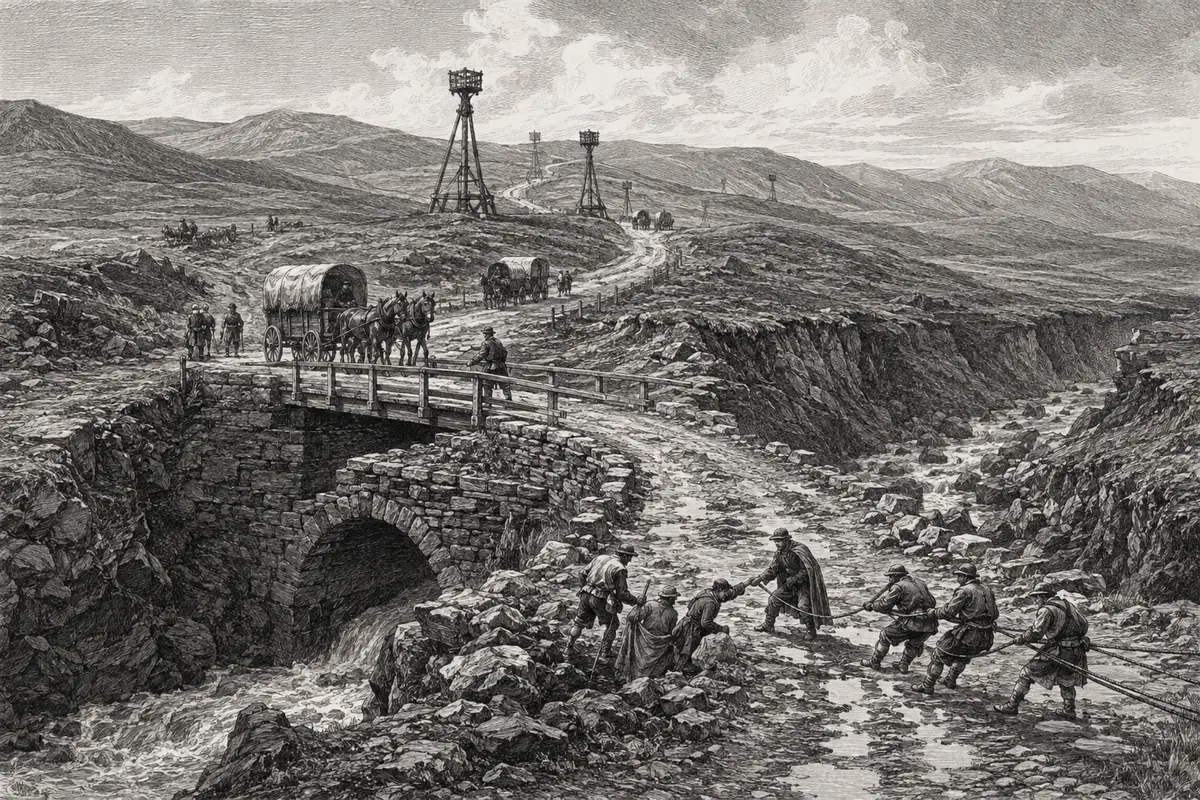
They found the last missing traveler alive because the cook had lied about the copper.
He confessed near noon, after the east and west rescue crews joined through the slide and the names were read for a fourth time.
“I did not send the boy for water,” he said. “I sent him to steal onions from the farm wagon. If I said that, his mother would hear.”
Theo looked at the list. “Where would he go after stealing them?”
“Back path. He knows the pass.”
Mira unfolded her weather-stained map. A maintenance path climbed above the retaining wall and rejoined the road east of the collapse.
“Not under stone,” she said.
They found the boy in a shepherd’s hut two miles away with a sack of onions, a twisted ankle, and an opinion that the entire rescue had been excessive.
When the messenger returned with him, Sabine drew a line through the last uncertain name.
“All accounted for,” she said.
The words traveled down the broken road. Workers repeated them, quieter each time, until they reached the families waiting under the cliff.
Seven people had died in the collapse. Fourteen had been pulled alive from stone or mud. Another nine had cleared the fall and returned to help. No count made the dead smaller. No honesty required the living to withhold relief.
Theo sat on an overturned grain box and discovered he could no longer straighten his knees.
Thomas lowered himself beside him. One sleeve had torn from shoulder to elbow. “You lean left when tired.”
“The road does.”
“Regional defect.”
“You remembered.”
Thomas offered him half an onion.
Theo stared at it. “Raw?”
“The cook is guarding the pot.”
“We saved his assistant.”
“The pot remains outside our authority.”
They ate the onion.
Nell found them before they could deny it. “Both of you have the judgment of damp dogs.”
“Dogs cook onions?” Theo asked.
“Better than you.” She inspected the cut on Thomas’s arm, then pressed two fingers beneath Theo’s jaw. “Swallow.”
“I already did.”
“Again.”
He swallowed. She handed him water.
Mira arrived with the recovered boy’s sack. “Cook surrendered the onions after I explained evidence custody.”
Thomas looked almost betrayed. “You lied.”
“I used a term he respected.”
Sabine joined them carrying five tin cups of stew.
She gave Theo one last.
“Probationer Avelos,” she said loudly enough for the road crew to hear, “your signal discipline preserved two rescue lines and prevented an unsafe removal. Well done.”
Public credit made him sit straighter despite his knees.
“Thank you, Lieutenant.”
“Your first survivor count included an unverified kitchen thief.”
“A balanced review.”
“Eat.”
The unit sat shoulder to shoulder on the grain box because no one had energy to find another seat. Thomas’s knee pressed against Theo’s. Nell stole his bread. Mira corrected the rescue map while holding the slate on Sabine’s back. It was not family. It was better than friendship announced before evidence. Each of them knew what the others had done when stone moved.
For one hour, Theo allowed the Guard to be exactly what he had wanted it to be.
North Coast Command received them with hot baths, two days of medical rest, and a mountain of paper designed to prove neither had been enjoyed improperly.
Theo filed signal logs, survivor counts, relay failures, equipment loss, and one explanation for why a lute case now bore the imprint of a wagon wheel. The quartermaster read that page twice.
“Operational necessity?” she asked.
“It kept message slips dry.”
“Could a standard dispatch box have served?”
“Yes.”
“Did you have one?”
“Under several tons of East Road.”
She approved repair.
The public rescue notice named all five members of Unit Twelve and the road crews. It listed the seven dead. It did not assign blame before the wall inspection concluded. Theo read it once, then again looking for the hidden turn. There was none.
The East Road families came to Command two weeks later for the public review. Elia walked between her parents wearing a red scarf and stopped when she recognized Theo.
“You tapped wrong,” she told him.
Her father looked mortified. “She means the song.”
“The third round repeats before the turn,” Elia said. “You skipped it.”
Theo considered the rescue beat he had sent through stone. She was right.
“I apologize.”
“It was hard to sing.”
“That was the stone.”
“Some of it.”
She demonstrated by tapping his signal board. He corrected the pattern in the incident appendix, noting that the child had identified the error. A tiny fact, useless to heroism and important to the person who had depended on it.
Bran the quarryman attended on crutches. He gave Thomas a new wedge forged to the correct load angle and Nell a list of every instruction he had ignored. To Theo he gave nothing.
“You kept me talking,” Bran said. “That was enough.”
The review ended with road workers authorized to close the entire pass during future wall warnings. Merchants protested the cost. Families supported it. The Guard’s good work produced a rule, and the rule produced new arguments. Nothing stayed a clean victory for long.
Good records existed. That mattered.
On the second afternoon, Sabine summoned him to the field office. A brass access token lay on her desk.
“Probation review,” she said. “You have been granted level-two mission records for the next quarter.”
Theo picked it up. “Because of East Road?”
“Because you performed your role, improved the plan through command, and documented uncertainty without decorating yourself.”
“I mentioned the lute case.”
“The quartermaster decorated you.”
The token bore his probationer number and a small open bridge. Level two allowed regional incident files, transfer requests connected to his unit’s cases, and technical appendices hidden from public findings.
Evan’s disposition sat in his memory like an unfinished measure.
Sabine saw him decide. “Access is not permission to conduct an inquiry.”
“It permits connected transfer requests.”
“It does.”
“Our destination request has no answer.”
“It has no answer yet.”
“How long is ordinary?”
“For prisoner transfer, five days. For Special Inquiry, there is no published standard.”
“Then I would like to discover the unpublished one.”
Sabine leaned back. “Use the records counter. Ask direct questions. Keep a copy of every request. If anyone orders you to stop, you stop and bring the order to me.”
“You’re allowing it.”
“I am defining it.”
The distinction felt less like a fence than it once had.
Theo took the token to the transfer office.
The clerk entered Evan’s file number, checked Theo’s access, and turned a page in the route ledger.
“Assessment transfer completed,” she said.
“Destination?”
“Special Inquiry.”
“That is an office.”
“Correct.”
“Which facility received him?”
She searched again. Her finger slowed.
“No receiving facility listed.”
“Forwarding authority?”
Another page.
“None.”
“Prison, treatment center, court district?”
“None.”
Theo placed the brass token on the counter. “What happens if his family sends a letter?”
The clerk looked toward the supervisor’s desk.
“It returns,” she said.
“With what reason?”
“No forwarding address.”
Theo thought of Evan holding out his hands while Dunlow cheered.
“Print that,” he said.
The clerk hesitated.
“Level two,” Theo reminded her.
She copied the empty fields and pressed the office seal beneath them.
The page contained almost nothing. That was what made it evidence.